Sunday, May 19, 2013

Kicking and Screaming


365 Films

Entry #108

Kicking and Screaming (1995)

Directed by Noah Baumbach


Kicking and Screaming is the one Baumbach title with which I have a somewhat limited relationship.  I don’t think I had any idea of its existence when released in 1995, and unfortunately, its title became re-appropriated by a horrendous Will Farrell soccer comedy ten years later.  Long story short, Baumbach appeared to me half formed as if by magic in 2004 with The Life Aquatic, then as a fully realized human being with The Squid and the Whale a year later.  I had no interest in any of his career output prior to that.  Damn, I keep forgetting how hard it is to convey sarcasm through toneless words on a screen (man, am I annoying) and should take this opportunity to point out that I think one should always examine the entirety of a creative output should they happen to stumble upon an artist for which they have great respect.  With all that being said, Kicking and Screaming is tremendously funny and is a damn near perfect display of Baumbach’s remarkably adroit skill (in his mid twenties no less!) with regards to writing dialogue and dynamics for groups.  The characters in Kicking and Screaming are all  barely clinging to merely the faintest semblance of their collegiate life and yet Baumbach gracefully posits them all as completely unique individuals who are just happening to suffer under a collective delusion.  It’s as if he found a way to remind us that even when they all attempt to sound like one another, the individualism inherent to their upbringing and education forces them to “interpret” what they believe to be collective dynamic of the group.  Kicking and Screaming might be as visually primitive as any first time feature has the right to be, it should be noted that this is merely a result of the budget.  Baumbach’s dexterity with comedic timing and character blocking is incredibly evident throughout as are his miraculous gifts for writing spiky, conversational dialogue.  To sum up, he makes up for it tremendously in other departments of directing.  The characters in this film are constantly aware of the clichéd stasis of their own lives, yet they remain powerless to do anything about it.  Whether that lack of power is a legitimate force or rather a self-imposed doomed fate is the gray area in which Baumbach aims to reside.  There is no answer to the post collegiate dilemma, but it is telling that the film concludes with a flashback to a conversation wherein one character tells another how he can’t wait to grow old with her.  These guys may not know what they want out of life, they just know that they’ll always want something else.  Baumbach’s masterstroke is letting us decide whether this is defeat or victory.  


Greenberg


365 Films

Entry #107

Greenberg (2010)

Directed by Noah Baumbach


Now remember how I just told you that Margot at the Wedding was intentionally off-putting?  Forget all of that because I don’t think it holds a candle to the title character and the entire film of Greenberg.  I know people who detest the very idea of this film (all for legitimate reasons of course) and there was even a piece written in the AV Club about the specific moment where the film lost one of its critics.  That moment, for your own edification, was when Greenberg (Ben Stiller) storms out of Florence’s (Greta Gerwig) apartment for no less an offense than telling an anecdote that doesn’t quite live up to his own high conversational standards.  In case you were wondering, that scene works for me because it’s a genuine moment of surprise and therefore comedy when Greenberg’s character displays yet another stunning lack of social graces around people he supposedly likes.  Rewinding a bit, in taking a page from the romantic comedy playbook, Greenberg begins as though it is dying to tell the story of two lost souls who connect through sheer happenstance when one flies in from New York to LA to house sit for his brother while he and his family are visiting Vietnam while the other also happens to be the personal assistant to that brother.  I believe that the likeliness with which one is inclined to stay with the film is pretty much tested by the time these two meet alone and in a sexual context for the first time.  When one of the most awkward, halted sex scenes ever committed to film occurs, you’re either watching with a fascinated kind of horror as these two are continually pulled together and apart or you’re pissed off beyond all belief by the fact that this incredibly charming and seemingly competent young woman is allowing this pathetic excuse for a human being to constantly weasel his way into her life.  Yet, even in that dichotomous push-pull does Baumbach explore territory that few comedies let alone romantic comedies ever dare to tread.  In allowing no concrete, specific reason for these two to become romantically linked, the film becomes somewhat of a Meta commentary on the entirety of the romantic comedy genre.  It is here that we see what may be the fullest expression of Baumbach’s unique ability to take traditional genre elements (if they can be called that) and push them to their utmost extreme.  Rather than finding this alienating, I find it liberating how it brings the film to a particularly emotional climax that feels honest and earned and never like a cheat.  I see this film as Baumbach taking the stunted intellectual-artistic type character that has become his trademark, drag him into middle age, and suddenly thrust him into the “real world” that consists of the rest of Hollywood’s cinematic output.  In breaking free from the rarified environs that made up his five previous features (it can’t just be a random coincidence that Greenberg takes place in Hollywood), Greenberg shows Baumbach holding up a truly revealing self-portrait.  In that regard, Greenberg is Baumbach at his most merciless and self-lacerating, but also at his self-deprecatingly compassionate.     


Margot At The Wedding


365 Films

Entry #106

Margot At The Wedding (2007)

Directed by Noah Baumbach


If people were put off by the abrasive nature of The Squid and the Whale, Noah Baumbach’s follow up Margot at the Wedding, is like a cinematic throwing down of the likability gauntlet.  To me, this is evident in the sequence late in the film, when the ostensible heroine Margot is giving a reading/discussion of her latest work at a bookstore near her family house where sister Pauline is about to get married.  The man interviewing her is local gad-about Dick Koosman (nice name by the way) and he begins to press her about the autobiographical details of her most recent novel, in particular, the grotesque portrayal of the father character.  The interview transitions into an unbearable amount of awkwardness when Dick tells Margot that he thinks the father could actually be, a stand-in for her.  To me, this scene has always read as somewhat of a rebuke to the critics who insisted upon asking Baumbach to bore into the personal history of his family details in relation to the content of The Squid and the Whale.  This scene (and the entirety of the film) represents Baumbach telling those people to have at it with this film, an almost flippant invitation to spend an inordinate amount of time with some truly toxic people and try to mine from it whatever clues about his personal life that they can.  It’s a challenge that also extends to the audience (obviously) and I can remember the distinct chill in the theater when I first saw Margot at the 2007 AFI Film Festival shortly before the films theatrical release that Thanksgiving.  People were put-off, annoyed, and most of all extremely uncomfortable by the poisonous tip of Baumbach’s writing implement.  I, personally loved it, and find Margot to be a much braver and bolder work than Squid, if not as entirely successful.  The aspect of the film I find most interesting (in particular when looked at in relation to Baumbach’s other work) is how much more advanced his visual story telling acumen had become at that point.  The editing and framing are sickeningly claustrophobic, as if we are tip- toeing and whizzing around each conversation, frantically trying to avoid the next personal blow out.  The squalid gray sky color palette and bleak, windy landscape signal an understanding of location and character that makes us feel at once alien and completely ingrained to the place these people call home.  Margot is also a testament to Baumbach’s endless ability with actors, as each performer shows tremendous skill at yo-yoing our sympathy and disdain back and forth and with equal measure.  The film also represents a high mark in the Baumbach catalogue in the Claude character (Margot’s son) for its portrayal of adolescent body transition and how not only does your attitude change about yourself but everyone else’s around you does as well.  Margot at the Wedding is most certainly not a one size fits all piece of filmmaking, but for those willing to indulge in its misanthropic wavelength, its pleasures are endless and consistently rewarding.


Wednesday, May 15, 2013

The Squid and the Whale


365 Films

Entry #105

The Squid and The Whale (2005)

Directed by Noah Baumbach


I have a confession to make: my original understanding was that Noah Baumbach’s The Squid and the Whale was a spin off of Wes Anderson’s The Life Aquatic (released the previous year).  It made a little bit of sense (I think), both have aquatic elements in the title, Baumbach was a co-writer on Life, and Anderson was a producer on Squid.  I think it’s also entirely possible that I mixed up my Jeffs and thought that Jeff Goldblum was in Squid instead of Jeff Daniels.  Luckily Baumbach made the right call with Daniels and cast him in a role that quite possibly re-defined his career (it certainly helped launch the lovable asshole character that The Newsroom has made its center piece).  More to the point, Squid has absolutely nothing to do with The Life Aquatic and is rather a great film in its own right as a quasi-biographical look at divorce from within an affluent Park Slope literary family.  The most astonishing aspect of Baumbach’s third feature is the fact that it is only 81 minutes long (76 if you don’t include the end credits) and it is, as Daniels’ Bernard Berkman would put it, very dense.  Every single conversation verbally mirrors the physical competition of tennis and ping-pong as seen throughout the film.  The entire film could be seen as an extended series of competitive events with characters claiming ownership of ideas, memories, and their perspective sides of the marital split.  As the film breezes by, your eyes are constantly darting back and forth as if in a tennis match.  These are characters whose personal language define and shield them from themselves and each other.  Baumbach requires a lot of concentration to follow the trail of breadcrumbs to figure these people out.  Brilliant screenplay aside, The Squid and the Whale is most commendable for its strict refusal to bathe its musings on family and male adolescence with a suffocating nostalgic glow.  The 80’s period details are tangible and subtle while never loudly pointing a blinking arrow to big hair and acid washed jeans (seriously, we need to stop fucking fetishizing the 80’s…and the 90’s for that matter but go nuts with the early aughts).  Most impressively of all, Baumbach refuses to make strict or clear-cut heroes and villains out of his characters.  Nobody stumbles into abysmal failure and nobody gets an easy redemption either, they are simply entangled forever in this conflict like the titular creatures of the sea.  This is what eldest son Walt ultimately has to grapple with, instead of embracing the maternal warmth of his mother during childhood and the present day adulation/mimicry of his father.  He has to see his parents for who they are, in all of their failed, humble glory.  Where most films about “coming of age” are content in the writing to inject their current wisdom into their teenage self, Baumbach refuses to let his cinematic stand-in off the hook.  The characters in the film (particularly Walt) are more than happy to fire off their meaningless sharp-edged critiques in vain attempts to claim whatever competitive edge they can over one another.  It is only at the end, when Walt finally comes face to face with the squid and the whale at the natural history museum, does anybody in the film begin to see him or herself as they really are.  On the other hand, Walt is only looking at a replication of nature rather than the real thing.  Then again, in Baumbach’s world of brilliant failures, that’s close enough.     


PS 
I know this isn't the trailer but A) nobody will notice either way and B) I couldn't find the damn thing.  Besides AO Scott has a much sharper mind than I do, so consider this me doing you all a favor. 

Tuesday, May 14, 2013

Oslo, August 31st


365 Films

Entry #104

Oslo, August 31st (2011)

Directed by Joachim Trier


I’m going to begin this particular entry with a line stolen from Eels front man, E that was written when describing the difference between the bands’ first two albums.  I have an incredibly specific memory of thieving this specific piece of verbiage prior to this; however, an incredibly lazy Google search has not yielded any such instances.  If there any dedicated sleuths out there who can dig up this lazy piece of self-plagiarizing plagiarism, I tell ya what, I’ll take you out for a steak dinner.  And if that’s not your thing, I’ll let you pick one of the 365 movies.  The line in question is if Reprise was Joachim Trier’s filmmaking calling card to the world, than Oslo, August 31st is the phone call in the middle of the night that nobody wants to answer.  The primary observation that fascinates me most about Oslo is how it is, in some ways, a spiritual sequel to Reprise, but in other ways is almost it’s polar opposite.  Where the first film is flippant, warm, and quick to the cultural pulse and pace of youth.  Oslo is a film populated by ghosts and it’s pace is such that (again, in comparison to Reprise) one can’t help but notice that where the prior film moves along at an agitated clip, compressing massive amounts of actual time into a few minutes of screen time.   Oslo is nearing middle age, and seems to trudge endlessly towards its inevitable conclusion in only a twenty-four hour time span.  I don’t think I can stress enough how much of a bummer this movie is; it’s an unrelentingly bleak look at an extinguished life.  And where some filmmakers would chose to take the redemptive route, Trier avoids that well-worn path altogether and it’s in the film’s sobering observations on city life where the film becomes something more than just another long day’s journey into night.  Trier captures something about his hometown of Oslo that is germane to any major metropolitan area around the world.  That is the idea that life in a city can be simultaneously liberating and suffocating.  That may not sound like such a radical reading on this piece, but I am much more interested in the way Trier chooses to cinematically represent these ideas.  The opening audio collage for example, clues us in immediately to the painful reality that this is a city populated by ghosts.  As the voice over jumps from person to person, the visuals seem to do the same thing.  Capturing an entire cities’ worth of intimate home movies capped up by the demolition of the Phillips building from 2000.  The key to this introduction is that these ghosts are haunted by joyful memories rather than devastating ones.  Mournful reminders of a time that seemed infinite in the present, but is now reduced to little more than the rubble of a once mighty skyscraper.  Another example of this is the show stopping centerpiece sequence of the film, when the main character Anders sits down in a café and begins to absorb snippets of the conversations around him.  These aural daydreams then lead to visual connections, as he tries to imagine the lives of two strangers who pass by outside on the street.  The café sequence is startling because it of how it creeps up on Anders, and eventually, us.  It begins as a bit of a lark, a playful bit of casual spying.  But the more Anders listens, the more disconnected he begins to feel.  The more swallowed up by his own shattered memories he becomes.  The café is full of life, but all he can hear is the life he has voluntarily discarded, and rather than pick up the pieces, he chooses to leave them as they lie.  It’s hard to speak so rapturously about this movie without sounding like a pompous buffoon, but part of what makes the film so bearable is its ceaseless commitment to sincerity and compassionate humanity.  Mind you, these qualities are never at the expense of the trenchant, painful insights the film has about its characters and their actions.  This approach is merely emblematic of the masterly control Trier has over his material.  It’s his vision of a generation that makes the entire film, from frame one to its quiet climax, all the more shattering.


Monday, May 13, 2013

Reprise


365 Films

Entry #103

Reprise (2006)

Directed by Joachim Trier


Reprise is a film that should, by all accounts, be irredeemably insufferable.  This new wave influenced tale of two Oslo young authors dealing with the aftermath of each having their first novel published should resonate with about a fraction of the population.  The marvel of Reprise is its ability to infuse its world with such life and vibrancy that it becomes awfully hard not to completely understand and know these characters even from the very beginning all the way until the final shot.  Stylized without becoming over bearing, emotionally resonant without resorting to mopey navel gazing, and possessing a keen insight into the world of its characters, Reprise avoids every single pratfall of the young male artist coming of age drama.  The first thing one will notice is how funny the film is, how much warmth it creates within the group of friends that constitutes its center.  This is a film that is very much about how individuals behave in a group and how even within people who have known you your entire life; you will always be subjected to labels and constrictions.  By the end of the film, each character in this film has violated those limitations and as a result, drastically altered the course in which they thought they were heading.  The anonymous voice over that punctuates the proceedings serves not only to place the characters within the context of a novel that one of the two leads might be writing, but also to carefully dissect the space in which we all live where the word would becomes the our lives’ all encompassing collective idea.  This would happen if only this would happen and so on and so forth.  The characters in Reprise live in a world where they are doomed to make the same mistakes as the creations of their favorite selections of popular culture.  Whether it’s a band that fell apart in its prime, or a literary reclusive genius that wrote one great novel and burned out just as quickly, Reprise is all about making your mark and suffering intensely when it’s your time.  One of the most difficult life lessons to learn is when the cultural detritus with which you’ve grown to saturate yourself becomes the weight that keeps you from soaring.  As intellectually stimulating and richly rewarding as it is, one can very easily become lost inside of it.  The characters in Reprise learn nothing as simple as a life lesson to keep them from living inside their own heads, but by the end of the film, you get the distinct impression that they won’t least repeat their mistakes.  And perhaps most importantly, the viewer has learned to root for them as well.           


Sunday, May 12, 2013

The Adventures of Robin Hood


365 Films

Entry #102

The Adventures of Robin Hood (1938)

Directed by Michael Curtiz and William Keighley


In my flippant, incredibly irritating way, I sometimes have the tendency to speak rather disparagingly about studio filmmaking.  I scoff at movies made by committee and the blatant homogenization that results from it.  It’s all a bit silly when you look at the entirety of film history, for there are a wide of variety of wonderful movies borne precisely out of this process.  Warner Bros’ The Adventures of Robin Hood is a sterling example of such a film.  Splendidly shot, featuring an incomparable score, cleverly written, and utilizing a cast that is absolutely perfect, Robin Hood is certainly one the greatest “escapist” movies of all time.  It’s such an absolute joy to be swept up in, that you can’t help but sit back and admire the collective creative genius that went into its conception.  Assembled from the usual suspects of Warner Bros stock company in the mid to late 30’s and written to a polish by a handful of screenwriters, Robin is certainly a Warner Bros’ picture more so than any individual director.  It doesn’t hurt that one of its directors, Michael Curtiz, would go on to direct the immortal Casablanca, but even he was only a replacement on Robin Hood as this was a film that was going to be willed into existence by its studio no matter what road blocks were placed in front of it.  These days, it’s incredibly difficult to have sympathy for so-called “runaway” studio productions.  Tales begin to emerge of skyrocketing budgets and recklessly irresponsible behavior by all concerned parties that movies of the sort are virtually written off before they can be fairly judged.  Robin Hood was a very early example of that kind of production and while it’s then-astronomical two-million dollar budget would be considered a micro indie by today’s standards (I think that’s what Zach Braff recently proposed for his kickstarter fund), it is also hard to imagine Robin Hood without the costumes, sets, and dynamic action sequences.  That’s not to suggest that the astonishing physical grace of Errol Flynn was something that could be bought, but sometimes a plan just comes together.  Simply put, Robin Hood is the best possible final result of the “throw as much money at the screen as possible” studio mentality, and going into it’s seventy-fifth year, it shows no signs of stopping anytime soon.        


Saturday, May 11, 2013

Nixon


365 Films

Entry #101

Nixon (1996)

Directed by Oliver Stone


I’m sure eyes rolled and exasperated sighs were released the instant Oliver Stone announced his gargantuan 1996 presidential bio-pic epic Nixon was to be his next film.  So tarnished was Mr. Stone’s reputation with respect to his ability of putting “truthful” things on screen that the prospect of an even-handed treatment of (at the time) this country’s most controversial president seemed faint at best.  Perhaps it is Mr. Stone’s reputation as a cinematic muckraker that makes Nixon such a satisfying and compulsively watchable piece of historical storytelling.  In not merely settling for a hit job, but instead plumbing Mr. Nixon’s psychological depths as a figure of Greek tragedy, Mr. Stone made a film that is as perhaps how his subject would have made it.  Or maybe the better way of putting it would be to say this is the film Nixon would have made in his subconscious.  Largely sticking to the bio-pic structural tropes (tracing Nixon’s life from boy-hood to resignation), Nixon employs some of the same stylistic visual tics as Mr. Stone’s 1991 masterpiece JFK such as varying film stocks and whiplash inducing jumps from past to present and from a cinematic reality to a sort of paranoid induced fever dream.  Perhaps the most brilliant touch in all of Nixon is that is attempts to put the viewer as much inside its subject’s head as it possibly can.  That is to say, Mr. Stone allows us the distance to see the cripplingly flawed man at the center while simultaneously inducing our empathy for him.  That’s not to say the film lets him off the hook for anything that he did, only that it’s quite possible that life would be hell for anybody with the raging amount of bullshit that the man had bouncing around inside his head.  Nixon was one of those films that I studiously avoided upon its initial release.  To this day, I can’t quite figure out why that was because I was definitely a huge fan of JFK and this seemed to be in a similar vein.  I was perhaps scared off by what most people were scared off by, and that is the 3 hour plus run time of the picture.  The extended director’s cut or whatever you’d like to call it runs nearly four hours long.  Luckily, my brother was all-together obsessed with it when it came out and his reports back about all the crazy historical shit implied by the film just made it that much more frustrating that I skipped its theatrical release.  With detail-by-detail precision, I can remember my brother describing the scene to me where it is all but spelled out that Nixon but tacitly approved of the Kennedy assassination.  Call it irresponsible filmmaking or absolute bullshit but I was already enthralled.   It was much to my amazement that when I finally caught up with the film, I was astonished by how much it moved and what operatic power it yielded with dynamic strength.  I remember trying to tell somebody at work that the run time goes by in the snap of a finger, like a perpetual motion machine.  In an era when we have become unfortunately far too accustomed to lightweight, disposable, and paint by number biographies, Nixon still lands like a punch to the gut. 

PS 
You definitely need to watch the theatrical trailer.  It's really something else.  


Out of Sight


365 Films

Entry #100

Out Of Sight (1998)

Directed by Steven Soderbergh


Because I planned all along i.e. just realized that this was my 100th entry, I figured it would be best to select a film that was nothing less than a milestone in my love affair with the medium.  Steven Soderbergh’s Out of Sight was, is and remains to this day, a summer movie anomaly.  It has all the hallmarks of a universally accessible blockbuster (even though it most certainly was not one at the time of its release) along with containing an intriguing variety of art-film flourishes.  In fact, Out of Sight was when I first learned about filmmaking terms like lens flare, jump cut, and freeze-frame (freeze frame is pretty self-explanatory but I had never seen it utilized as effectively before).  I can remember so vividly what an undeniable visual knock out the film was for me.  The cinematography rendering each location and each character practically it’s own body temperature to be playfully fluctuated by Mr. Soderbergh and his screenwriter, Scott Frank.  Another fact worth pointing out is that I was completely unaware as to who Mr. Soderbergh was or the notion that this was some sort of return from the wilderness for him.  I had not seen, nor was the least bit familiar with his breakthrough film Sex, Lies, and Videotape nor had I seen any of the follow-ups that failed to register the same kind of unadulterated wide-spread appreciation.  It makes sense in retrospect because Out of Sight burns with an intensity of a filmmaker who has something to prove.  An intensity it should be stated that we have Schizopolis to thank for, but once again that is a topic for another blog entry.  As such, Out of Sight introduced me to the then radical notion that art house and Hollywood could mix and that one need not be the clichéd pointy headed, goatee-scratching intellectual to appreciate a filmmaker’s stylistic flourishes.  So enraptured was I with the film that I began devouring interview and article after interview and article about its director and was astonished with how down to earth and matter of fact he was about the whole thing.  He didn’t come off like a larger than life showbiz time, nor could I simply perceive him as an out of touch egg head.  He was somehow all of those things at once and none of them at the same time.  That effect is very similar to the spell cast by Out of Sight.  In the middle of it, it seems to glide along as gracefully and weightlessly as a world champion figure skater and it is only when it concludes do you realize how masterfully it has just executed it’s tale of lonely hearts and missed connections.  All told in an incredibly fluid cinematic style and with a pair of leads that have a romantic chemistry yet to be matched by any modern day equivalent.  Out of Sight is a summer movie that actually deserves to be called one and as it happens, it’s pretty damn funny too.  In other words, it’s a keeper regardless of what season it is.  Oh, I almost forgot, for those of you who have seen the Delaware College of Art and Design Summer camp film that I helped create back in 2002 will see how heavily indebted all of my "original" filmmaking ideas were to Out of Sight.  I hope we don't get sued for admitting that.      


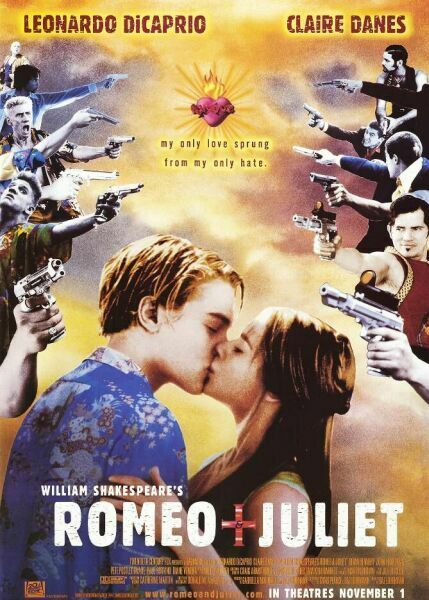
William Shakespeare's Romeo + Juliet


365 Films

Entry #99

William Shakespeare’s Romeo + Juliet (1996)

Directed by Baz Luhrmann


As we return to Baz-land, the thing that comes to mind first is how difficult it is to perceive of his 1996 Shakespeare update of Romeo + Juliet as just a movie.  As disastrous a prospect as a Shakespeare adaptation for the MTV Generation sounded back then, Luhrmann managed to combine the enduring timelessness of the original text with a showman’s eye for capturing a cultural moment.  So prophetic was his vision that he even managed to harness two icons of 90’s youth culture in his titular leads, Claire Danes and Leonardo DiCaprio, before society had deemed them so.  As it is today, Romeo + Juliet is not limited to the confining realm of a product, it is movement and a moment; one that will most likely never be duplicated.  What you have to understand about my perspective on this film is that it has evolved radically from when I first encountered it.  It was very difficult to be a pre-adolescent boy in the mid-90’s and not harbor just a tiny bit of animosity towards Mr. DiCaprio.  Not that it was based on anything as rational as a judgement of his talent or skill, but simply because every single female on the planet seemed to be in love with him.  And before I get any angry letters, rest assured I mean to imply hyperbole with that statement.  The world of a 12-year-old boy is very small indeed.  As the years marched on a little maturity and rationality went a long way with helping me return to Baz Luhrmann’s intoxicating vision.  Re-watching the film recently, I was struck by just how capably and graciously Luhrmann juggles the various visual influences that are bouncing around inside his and an entire generation’s head.  I suppose it helps to have a narrative foundation as sturdy as that of Shakespeare, but careening from a Sergio Leone style opening sequence to Romeo’s return to Verona which wouldn’t have looked out of place on an episode of COPS is an awfully tricky balancing act to pull off.  All the while retaining the power and layers of Shakespeare’s text coupled with a sprawling cast that always proves capable.  Romeo + Juliet is a grab bag of cultural and contextual landmarks that manages to not only solidify their staying power but also open them up to reveal several stimulating new dimensions.   


Wednesday, May 08, 2013

Summer Hours


365 Films

Entry #98

Summer Hours (2008)

Directed by Olivier Assayas


I don’t think there is a director working today who can capture movement quite like Olivier Assayas.  This skill is put to superlative execution in his 2008 family-drama, Summer Hours.  I knew very little of Mr. Assayas’ work before this film, for it was the first one of his I actually saw.  Instead, I had vague memories of trailers for the two techno-thrillers he made prior to this, Boarding Gate and Demonlover.  To be brutally honest, both looked like fresh off the shelf direct to DVD material but if I may offer a lesson to be learned by my ignorance, it is to never judge a film by its trailer.  Granted, I still haven’t seen Boarding Gate or Demonlover but going off of Assayas’ collective output since, which includes, Summer Hours, Carlos, and the now in theaters Something in the Air, I feel as though my prejudice will once again be proven unfounded.  Such is the attitude I had going into Summer Hours as I sank into my spring-loaded seat in the Laemmle Encino theater where it was playing, another lesson borne of ignorance, sometimes no expectations are the best kind of expectations to have.  As the next hour and forty-three minutes unspooled, I was completely transported.  Not to a magical realm or a mystical portal, but to that immaculate region where cinema and memory collide to produce a truly shared evocation of humanity.  Summer Hours concerns a trio of adult siblings dealing with the recent death of their Mother and the subsequent decisions that must be made regarding the family estate and the highly desirable collection of artworks contained therein.  It would be enough for the film merely to address the issues of French national identity, the conflict between public and private displays of art, and the incredibly complex relationships between adult siblings.  All of these are elements that are rarely handled well in cinema and can lead to a lot of leaden bullet point dialogue or an orgy of melodramatic relationship climaxes.  Assayas makes a ballet out of his dialogue (hence his agility with movement) and renders each character with the resultant depth and humanity to modulate these intellectual abstractions to the realm of the instinctual.  To watch Summer Hours is to engage with people and ideas, making the acceptance of one part and parcel with the other.  It’s an extremely masterful piece of writing and directing.  With that being said, the main issue I would like to address in regards to this film is an entirely personal one for me.  It could be that I’m just looking for an explanation as to why I get so choked up every time I watch it but there is a reason we have specific memories, right?  It’s hard for me to watch this film and not think about the move my family made from the house in which we spent the better part of ten years.  It’s a very strange sensation to leave the house where you ostensibly formed your being and it is difficult to describe only because each experience is so specific to each person.  Granted, my family’s situation is entirely different from the one faced in Summer Hours (there was no mountain of valuable art work to sort through unless you discount our collection of hand-made pottery from 1st grade art class) but I fail to bring to mind another film that so elegantly and poetically captures the utter despair that comes from looking at a barren room after everything has been packed up and boxed for a move.  What was once filled with clutter and mess has now been rendered back to its original state: cold and lifeless.  It may just be a collection of plywood and brick (or whatever houses are made of) and at the end of the day, a thing.  That doesn’t make it any easier to let go of, regardless of how irrational it is to hold on to it.  I’ll always be grateful to Summer Hours for not only helping me navigate through images and ideas from my own life (and life in general), but also introducing me to a truly great filmmaker.