I will attempt to unpack
the cultural force that is Demolition Man
with a personal anecdote. I’m
visiting my sister in the winter of 2009.
I arrive at Penn Station and hop on the subway to get to her apartment
in Brooklyn. I’m on the train,
minding my own business and keeping to myself as per usual. I’m traveling with my backpack and
travel bag. Flashback about three
years prior to the set of Nathaniel Carota’s A Slow Dissolve in Ketchum, Idaho where I’m busting my ass while
the assistant cameraman (for privacy’s sake let’s call him Gabe F. No, that’s
too obvious…G. Fonseca) sits around doing absolutely nothing (as was his habit). In our spare time G. Fonseca and I had
come up with a hypothetical sequel to Demolition Man titled Demolition Man 2: Phoenix Rising. Mr. Fonseca then attempted to write
that particular title on a piece of camera tape and attach it to the slate of
the film we were currently shooting.
We all had a good laugh even though I didn’t quite understand it. But I stuck that piece of tape to my
backpack as inspiration to get off my ass and make the Demolition Man we’d
spent at least 10 minutes dreaming about.
Back to winter of ’09 on the NYC subway, when an unkempt youngster
approaches me on the platform as we are both heading for the stairs. “Hey, that thing on your backpack, is
that real?” I reply, “No it was just a joke between my friend and I.” With a
hopeful look on his face, the guy says “Oh. That’s too bad because I got really
excited for a second when I thought they were actually making that movie.” Did I mention that this was one of
several random conversations I’ve had with complete strangers about our shared
desire for a Demolition Man 2? I
rest my case. Demolition Man is
here and it’s here to stay. If you
thought this was a long forgotten, destined to reign as king of the dustbin in
the bottom shelf of the TBS library title, then you thought WRONG my
friend. Demolition Man boasts
endless re-watch value, so much so that it somehow manages to be both better
and worse than you had previously thought with each subsequent viewing. That is no small feat. It features what is perhaps the greatest
Wesley Snipes performance in the history of cinema (also no small feat). And a vision of the future and Los
Angeles that is both prescient, yet bathed in the nostalgia for the time in
which it was made. Demolition Man,
in a lot of ways, is the ultimate 90’s movie. It’s a movie in which a violent dinosaur like Stallone (who
was on his way out career-wise back then…or so we thought), validates his
existence and proves the need for the Joel Silver/Jerry Bruckheimer mega
productions of the late 80’s early 90’s.
In its gently insidious way, Demolition Man reinforces the idea that not
only do you need to watch this movie for entertainment value but that you need
to watch it for the future of the human race. If you don’t, than all we have to look forward to is Rob
Schneider’s constant mockery at your inability to use the three sea
shells. If that isn’t a grim
prognostication, I don’t know what is.
I will also take this time to admonish you all to read the Demolition
Man novelization by Robert Tine. I
read it before I saw the movie because I could not find a suitable chaperone to
accompany me when it was in theaters.
If any of you have seen The Simpsons episode where Bart is forbidden
from seeing the Itchy and Scratchy movie, so he instead reads the entirety of the Norman Mailer novelization: that’s exactly what it was like.
A Bronx Tale, Robert
DeNiro’s directorial debut, concerns the coming of age and subsequent battle
for the soul of one Calogero Anello.
The two opposing forces are the boy’s father Lorenzo and the local crime
boss Sonny. As Caloegero navigates
the tricky tight rope between a law-abiding life and that of a hoodlum, a
larger portrait of the Bronx in 1960s emerges. A Bronx Tale originated as a one-man show created by Chazz
Palmenteri (who also plays Sonny in the film). In the transition from stage to screen the film wound up in
the directorial hands of Robert DeNiro (who plays Lorenzo in the film). I offer this bit of back-story to you
now because none of it made a damn bit of sense to me when I watched the movie
from beginning to end on its HBO Saturday night premiere. In collecting my thoughts about A Bronx
Tale, I began to feel a deep nostalgic longing for the HBO Saturday night
movie. Creating a legacy of
quality the network has long since abandoned (this years premieres included The
Three Stooges, Battleship, Project X, the list goes on and on…), the Saturday
night movie offered me the window into a world of film outside of the
multiplex. Don’t get me wrong,
they showed a lot of crap, but films like A Bronx Tale made the indelible impression
upon me that Cliffhanger wasn’t the only
option at the video store anymore.
Again, none of this mattered when I switched on the TV at eight o’clock
on whatever long ago Saturday night that happened to be. It’s possible that pure chance and
coincidence drew to me to this film.
The funny thing is, there is one dialogue exchange in the film that I
remember in exact detail. The
scene in question is when Sonny teaches Calogero about the door test. The door test involves determining
whether a potential date is right for you by observing if she reaches over to
open the driver door in your car after you have opened the passenger door for
her. Why this patriarchal and
antiquated ritual stuck with me for all these years I have no idea, but that’s
literally all I remember. Even the
bare bones plot description I provided came from the wikipedia summary. You might ask why in god’s name did you
pick this film to write about for your 365 blog? I have no conclusive answer for this. I don’t remember the film at all but I
remember how it served as an introduction to the acting titan known as Robert
DeNiro. I remember the tragic inevitability
of the ending and how that shaped my view of the mob sagas I would consume
ravenously in the coming years. A
Bronx Tale was where I started to connect the dots between the content on
screen and the personality of the creators behind the scenes. Even if I don’t remember the specifics,
I will be forever grateful to it for that.
When I selected The Fugitive
for this blog, I never thought about how I would eventually tackle it. On the surface there’s nothing that
remarkable embedded in my memories of it.
It’s not a film that has inspired any kind of controversial re-interpretation
in the intervening years. For lack
of a better expression, it is what it is.
Then I thought about it some more and in a way, that’s kind of
marvelous. It’s fair to say that
I’ve become fairly disillusioned with the state of modern actions films. What passes for action these days is
usually infested with superheroes, Jason Statham, or starring a bunch of old
dinosaurs from the 80’s with Jason Statham for support. Since we’re on the subject, I feel that
I have given a pretty fair shake to Mr. Statham and his films and the only
thing I can come up with is: this is the best we can do? Getting back to the matter at hand, the
years have been very kind to The Fugitive. It has an endearing no-nonsense quality about the action and
story. The direction by Andrew
Davis, while always spot-on, never distracts with that stab-you-in-the-face
assaultive approach to cinema that seems to have taken over Hollywood. We seem to have lost our patience for the
workman approach to action filmmaking designated by the likes of Mr. Davis,
John McTiernan, or Wolfgang Petersen.
The train/bus crash escape sequence alone is an incredible action set
piece. Filled with dynamic sudden
twists of luck and an escalating sense of exhilarating danger from otherwise ordinary
means of public transportation. It’s
a showstopper in the best sense of the word. This was certainly one of my first acknowledgements of what
a “set-piece” was in an action movie.
I can’t think of a better film to introduce me to this incredibly
rewarding cinematic practice. But
before I fall into that trap of bemoaning the loss of how things “used to be”,
I will point out that The Fugitive certainly had its moment in the sun. It was nominated for seven academy
awards, winning supporting actor for Tommy Lee Jones. It also dominated the pop-culture landscape from the year it
was released to the end of the decade.
I can think of at least several different Simpsons parodies right off
the top of my head. I think
all of that is a testament to what a well crafted, ingeniously devised, and
character heavy action movie can accomplish when given the right amount of
care. It is entirely possible that
this kind of movie can have a new renaissance in our day and age. We just have to demand it.
I’ll try to make this short and sweet because I really don’t
have that much to say about Renny Harlin and Sylvester Stallone’s mountain
climber-rescue-action movie Cliffhanger. I don’t mean to disparage the film but
this is definitely one of those entries wherein the entire concept of doing
this blog in the first place backfires.
I’m including it because if I wish to present the entirety of my
cinematic education, I have to show it as it happened, the warts and all
truth. When you are an aspiring,
young cinephile, the most treasured of all your possessions is your family’s
video-store rental membership card.
It’s astonishing that in such a short amount of time those elusive,
idol-like objects have all but gone extinct. My point is that when you rely on the video store as heavily
as my family did, you tend to get lazy in your selections. Why would I want to explore and seek
out new and interesting directors when there is Sylvester Stallone’s face
staring at me with his dead eyes as he dangles precariously over a snow-white
frozen abyss? The movie is called
Cliffhanger and literally, there is a guy hanging from a cliff on the box for
the videotape. How could I resist? That’s how it went for several weekends
in our house, A trip to the video store led to the two day acquisition of
Cliffhanger, followed by copious amounts of watching of Cliffhanger,
culminating in the ultimate return of Cliffhanger to its home at West Coast
Video. This went on for several
weekends. It got even worse when a
blizzard caused a pipe in our school to freeze and subsequently burst. A couple of weeks off of school and
unlimited time to watch Cliffhanger definitely add up to several million-brain
cells killed instantly. What’s
funny about all this is whenever Cliffhanger pops up on cable these days (I do
own the DVD but it’s back on the east coast, so Mom, feel free to watch that
whenever you want), I’m always willing to set aside a few hours to see how Gabe
Walker will salvage the one-hundred-million dollars in uncirculated treasury
bills while foiling the evil schemes of former military intelligence officer
Eric Qualen and ruthless gang of criminals. All the while struggling to stay alive in an incredibly
harsh and perilous region of the Rocky Mountains. As far as action movies go, it’s an incredibly well oiled
machine that serves no purpose other than to hold you tight in its vice-like
grip. Director Renny Harlin
succeeds at this in remarkable fashion.
He brings a sharp-eye to pretty standard material and is inventive and
clever enough in his action staging to never let the monotony of the story and
setting overwhelm the experience. The
subsequent decade of Nate and I endlessly quoting the film’s most price-less
lines say something about the screenplay.
What that is, I can’t be entirely certain, but it’s something. And the trailer is pretty fuckin' awesome.
For the six of you who are still reading this thing, you may
have noticed that I adopt a somewhat flippant tone for these entries. There is no rational explanation as to
why that is, I can only say that I gotta write 365 of these so let me have this
one little outlet for entertaining myself, please. That philosophy is all well and good until you come upon an
entry like Schindler’s List where
even the very mention of the title sends a seismic tremor of chills down my
spine. The tricky thing in writing
about Schindler’s List is that I saw the film when I was ten, in the late
winter of 1994. The film had just
won its seven academy awards (including best director and best picture) and
Spielberg had, only a year prior, tore his way into my subconscious with the
mammoth Jurassic Park. I’m not sure if this lets me off the
hook but as a ten-year-old, I had no real concept of the holocaust or World War
II in general. I had a vague
notion of this film being historically significant, but at the time, I was more
interested in seeing the new project by the guy who made the Jeff Goldblum-fights-
dinosaurs-movie. Its success at
the Oscars merely corroborated these pieces of evidence. We had
to see this film. What’s tricky
about seeing it as such a young age is that you quickly and methodically wish
to banish about 90% of its images out of your mind as soon as you leave the
theatre. All the arguments in the
ensuing years about the validity of cinematic representation of atrocities go
right out the window. By that
point, it’s too late, you’ve been scarred and the last thing you feel like
doing is re-visiting the nightmare.
Obviously, the experience of watching a film doesn’t come within a hare’s
breath of what millions of real life people suffered through and still
experience to this day, but I was ten and incredibly self-absorbed. That being said, the
over-whelming nature of the film and the mythic status it has obtained as an
act of remembrance instead of a film with characters and a story, make it
incredibly hard to judge it with concrete aesthetic assessments. I have only seen the film three times
in my entire life (at the most its been four). Therefore I will fail in offering you any kind of
contextualization or interpretation of the film in cinematic history. The best I can do is tell you that if The Last of the Mohicans was my “welcome
to the party” introduction to the world of movies for grown-ups (I can’t say
Adult Films, now can I?), Schindler’s List was when the shit got real. From this point on, there was no
turning back. I learned that while
movies have the power to entertain and delight; they also have the power to
induce intense bouts of sobbing followed by curling up into a fetal position on
the floor.
Some movies are so vivid that you remember the exact time,
place, and date on which you saw them.
Those details begin to morph with the actual film itself and intertwine
as they settle into your memories.
It gets to the point where the film and your memory of the time and
place in which you saw it become inexorably linked. When you watch the film again, not only are you taken back
on that journey to a magical world were Dinosaurs have been brought to life through
advanced cloning techniques, but also the time in your life when you first laid
eyes on that journey. I remember specifically
that we saw Jurassic Park (that would be Mom, Nate, and Tess) on its opening
day, which coincidentally was the last day of school of my third grade year in
June of ’93. In fact, school might
have literally just ended as we raced out the door to get to the AMC Painter’s
Crossing theater as quickly as possible.
Like pretty much all children, we were fascinated by the concept of
Dinosaurs wreaking havoc on a theme park designed to contain them. I don’t think I knew exactly who Steven
Spielberg was at that time.
Rather, I had no idea of the kind of event that a film of his would
promise to be. I had not seen Jaws
at this point, or Close Encounters.
I’m sure I had seen E.T. but I was far too young to register who
directed it or what that meant exactly.
I think the only Spielberg film I was aware of at this point was Hook,
and we all know how that turned out.
As a result, I went into Jurassic Park colder than any other Spielberg I’ve
seen since. I had no idea what to
expect. I suppose it’s moot at
this point to say that the film went over like gangbusters. It was a watershed moment for special
effects, summer movies, dinosaurs, and even Jeff Goldblum. He would go on to an incredibly
lucrative second career playing the anxious and neurotic scientist in a boatload
of other disaster movies. Jurassic
Park was an amazing movie-going experience for me as a nine-year-old. I remember jumping out of my seat when
the raptor bursts into frame after Sadler proudly boasts about turning on the
power. That being said, as
awe-inspiring and exhilarating as it is, Jurassic Park has not aged as well as
my personal favorite Spielberg films.
I don’t think it comes anywhere near Jaws in terms of a theme park ride
movie, as just one example. The
Indianapolis speech in that film alone, is more gut wrenching and compellingly
human than anything in Jurassic Park.
Nor does it come anywhere near his post-Saving Private Ryan oeuvre
(that’s right, I used the word). The
point is: he’s made plenty more entirely satisfying movies than Jurassic
Park. But very few struck such a
vivid chord as this one.
I suppose I have some ‘splainin’ to do about this particular
entry. No, this won’t be one of those
ironic appraisals of a previously-thought-to-be garbage title. I’m not going to try and convince you
that Passenger 57 is really a
sub-textual journey into the paralysis of grief and how that somehow parallels
with the corporatizing of private security in the airline industry. I merely offer Passenger 57 as my
gateway drug into the many pleasures that the action movie had to offer. It also introduced me to someone who
is, in my humble opinion, the greatest action movie star of the 20th
and subsequently 21st century. I’m talking about Tom Sizemore of
course, oh wait, I mean Wesley Snipes.
I always get those two mixed up.
Getting back to the point, Passenger 57 is the film that introduced the
world to Wesley Snipes: action star!
After making a big splash with a series of sports comedies followed by a
trio of dramas, two of which were directed by Spike Lee, Snipes became a household
name with Passenger 57. In what
barely passes for a warmed-over Die Hard rip-off, Snipes plays John Cutter, an
airline security expert who finds himself on a passenger plane held hostage by
terrorist Charles Rane and his all-star team of international freelance
terrorists. Cutter teams up with a plucky female flight attendant named Marti
to end the “Rane of Terror” on board.
That’s about it. There’s a
diversion to a county fair just so the entire action of the movie doesn’t take
place on a plane, and everything turns out exactly as you hope it would. It’s literally Under Siege on a plane,
that’s how far removed we are from even a Die Hard knock-off. I shouldn’t slag on the movie too
much. It provided me with thrills
a-plenty when I first encountered it.
Plus, it introduced me to my first movie star obsession in Mr.
Snipes. I followed his career with
great interest through the years and while his subsequent legal troubles have
robbed us of his cinematic presence, Passenger 57 is a sufficient reminder of
just how valuable he was to action movies. He is (in my opinion) the best actor of all the
late-80’s/early-90’s action stars and he had the most charisma of the bunch by
far. It’s no wonder they’ve been
desperately trying to get him to do an Expendables movie. Snipes’ performance in Passenger 57 has
certain stillness to it (I know, I know, shut up) and while most action stars
of that era amped up their machismo, what appealed to me about Snipes was his
discipline. He wasn’t an improviser like Willis, or a brick shit house like
Stallone, Schwarzenegger, or Van-Damme.
Snipes is a thinking man’s action hero who strategizes the next move
instead of impulsively impaling people with steam pipes And he knows karate! I miss him
every day.
I need to tread very delicately over this next entry because
I have come very close to losing a lot of friendships over my opinions on this
film and the one that preceded it.
On second thought, forget it, I fucking hate Home Alone and Home Alone 2. Admittedly I said that just to see if I
still had your attention, so I wouldn’t say that statement signifies the
entirety of complicated emotions that these films inspire. That is the reason why I am including
this film (and I guess, by association the first one) on my 365 list; I wish to
point out what happens when a film doesn’t grow up with you. Don’t get me wrong; I loved Home Alone
just as much as the next kid in 1990.
The child-hood fantasy of getting the house all to yourself, coupled
with the kid-power-friendly annihilation of two nefarious burglars (all with
home-made booby traps no less) was completely irresistible to me. Next up was Home Alone 2 and the
filmmakers pulled off quite a clever ruse in delivering the exact same movie
dressed up like the city of New York.
They even have the resourceful Kevin McAllister find an apartment in the
middle of renovation just to spring more booby-traps on the (apparently) amnesiac,
(definitely) moronic criminals.
Then I spent another ten to fifteen years watching and re-watching the
movies on video and something clicked along the way. The “Old Man Marley” subplot always bugged me in Home
Alone. I never understood why it
was necessary. Is it to prove that
you shouldn’t judge people, no matter how scary they look, or what rumors
you’ve heard about them? That’s all well and good, except for the fact that it
rings totally false when you consider the movie spends the last thirty minutes
pummeling two hapless, small-time burglars into a near death stupor. Shouldn’t Kevin have instead welcomed
Harry and Marv into his house with open arms and seek conference with them on
why they have chosen a life of crime? The same thing happens in Home Alone 2
when Kevin meets the Bird Lady of central park. Only this time it’s somehow even more offensive. A good portion of the narrative is
dedicated to Kevin learning about her life, about the pain she experienced
because of certain choices she made.
The filmmakers are asking us (again) to look past the surface and see
the true nature of people. Why
then, at the rousing finale of the film, does Kevin merely wave to her from his
penthouse at the plaza hotel? Shouldn’t the Christmas spirit have compelled him
to, I don’t know, fucking invite her upstairs instead of banishing her to the
bitter cold of Central Park? This
is a long-winded way of saying that these movies are complete and utter horseshit. They want to pluck our heart-strings by
a mother and son reuniting while laughing uproariously at two men getting shot,
stabbed, set on fire, crushed from above, and left for dead by a sadistic ten-year-old. Then again, the movie made 800 billion
dollars so what the hell do I know.
And to be perfectly honest, I watch the fucking thing every time it’s on
TV at Christmas. Don’t listen to
me. Gremlins 2 still kicks its ass as far as childhood memories of New York
on film go.We all have those,
right?
The Last of the Mohicans was a landmark movie for me. The circumstances under which I saw
this film will remain forever in the annals of Ethan lore. This was the first R-rated movie I ever
had the pleasure of seeing at the tender age of 8. Here’s what I remember: it was a Monday and we went to the
Christiana Mall specifically to see it.
This raises many intriguing questions. Why wasn’t I in school on a Monday? It’s possible that it
was a holiday weekend, I was sick, or I faked an illness. That last one doesn’t sound like me so
I’m going to go with holiday. The
odd part is that I specifically remember being aware of the fact that I should
have been in school on that day.
If that’s the case, it’s most likely that I was sick. But if I was sick, why was I going on a
field trip to a mall to see a two-hour long epic romance about the French and
Indian war? There are so many
tantalizing possibilities about which, I’m sure none of you give even the
faintest possibility of a shit.
Regardless of what actually happened, I remember the experience of
watching the movie so vividly. I
remember that this theater was the first time I saw a woman with a shaved
head. I remember the feeling of
being let into an exclusive club and the unbearable anticipation of seeing the
film and subsequently reporting back to my friends about it. I don’t think I had quite grasped the
notion of how much I loved movies at age eight. This film kick started the entire process if that was the
case. It doesn’t matter that I
barely retained any of the actual film, does it? Being an eight-year-old boy, the most memorable images of
the film were of a man being scalped, a man having his still-beating heart
ripped out, and a man being burned alive at the stake. It was frightening, it was exhilarating,
but most of all, it was new! I got
to be the toast of my third grade class for about five minutes. At which point they got bored of my
temporary visit to the adult world and moved on to something far more
interesting, a kickball game maybe.
I, on the other hand, was not ready to move on and like a hungry, hungry
hippo I only wanted more. I
suppose I was quite lucky to get Mohicans to pop my R-rated cherry. The movie has remained a perennial
favorite in our household due to my Mom’s open obsession with it. Later in life, I grew into a Michael
Mann obsession that began with Heat (the project after Mohicans) and has
continued with each subsequent film.
The fact that Daniel Day Lewis has grown in stature to an actor of
unfathomable talents and gifts probably doesn’t hurt either. So while the film itself may not have
set my particular world on fire, every time I get the chance to revisit (Mann
practically puts out a new cut every month) I am reminded of why it has
remained so firmly etched in my subconscious all these years. Mann’s thematic fascination with loners
hacking a life out of the frontier (be it a city or the actual wilderness), the
exhilarating and visceral action sequences, and the fact that the final thirty
minutes of this movie may be the best final thirty minutes of any movie in the
history of filmmaking make this a pretty fantastic introduction into the world
of Restricted Cinema.
Let’s see how I can pull
this one out of my ass. I haven’t
seen Death Becomes Her in well over a decade. I have some thoughts about it, but they are based mostly on
vague recollections and quasi-remembered ramblings. I had to do a quick wikipedia recap to even remember what
the fuck happens in this movie.
That reminds me, is wikipedia interested in being a sponsor of this
blog? I feel like I plug them
enough to be worthy of a few kick-backs.
I’m not actually sure how they’d pay me, but that doesn’t matter, we’ll
figure something out. Death
Becomes Her is about a past-her-prime actress and her life rival ingesting some
sort of vitality potion that makes them immortal. The main object of their rivalry is a nebbish-y plastic
surgeon who ultimately chooses a life that ends over spending an eternity with
these two nattering nabobs. If
that description sounds horribly misogynistic, I’d have to plead the fifth on
that one, but if anybody wishes to chime in with a comment feel free. The reason I am including this film on
my 365 list is because it was the first time a casual film-going experience
filled me with a verifiable amount of dread. I feel like if I ever get the chance to meet Mr. Zemeckis, my
line to him would be identical to that of Homer’s when he met Mel Brooks. I love that movie "Young Frankenstein"... scared the hell
out of me. I have an incredibly specific memory,
not of the movie, but of the ride home through the dark back roads of
Wilmington, Delaware. The radio
was blasting Haddaway’s What is Love and
all I could think about was, “one day, I am going to die.” Even the lyrics to the song itself
sounded like the ghostly echo of a spirit from the other side. The idea haunted me, and the fact that
the movie treated the concept of death with such blithe cynicism was even more
distressing. On second thought, maybe
it wasn’t What is Love? it could have
been CeCe Peniston’s Finally. Does it really make a difference? I have no idea how Death Becomes Her has
aged in the past twenty-one years; according to the wikipedia page it was not a
financial windfall for all concerned parties. I can’t imagine introspective thoughts of one’s own
mortality were the desired reaction by the filmmakers. Wow, that’s kind of a bummer, let me
see if I can wrap this up on a lighter note. If this helps, just imagine eight-year-old Ethan sitting in
the theater watching Death Becomes Her.
Instead of laughing at the cgi-enhanced-black-comedy-mayhem like
everybody else, he is cowering in his seat, hiding his eyes with his hands from
the images. If that doesn’t
inspire guffaws, I don’t know what will.
My first encounter with Bebe’s
Kids came from copious amounts of HBO watching that occupied the majority
of my youthful idle. The situation
in my household growing up was one of extreme liberalism regarding the content
to which I subject my young, impressionable eyes. I saw Last of the Mohicans and Schindler’s List, and Pulp
Fiction when I was nine and subsequently ten years old. Ratings didn’t mean a whole lot to my
parents and I am incredibly grateful to them for that. As a result, the ascendance of HBO meant
plentiful access to all kinds of scandalous material. I’ll let you make your skinemax joke on your own time…have
you made it yet? Good. Let’s move on. As far as I can remember, I’ve always had a fascination with
“subversive” animation. Who Framed
Roger Rabbit (Entry #1), The Simpsons, Cool World (1992, NOT on this blog),
Beavis and Butthead, Ren and Stimpy, the list goes on and on. And I don’t mean subversive in the
literal sense (none of these things were that offensive, for fuck’s sake), just
in the idea that they broke from the conventions of children’s animation in very
explicit and gleeful ways.
Ten-year-old Ethan felt like he was getting away with something watching
Bebe’s Kids (felt like being the key operative phrase there). I haven’t seen the film in god knows
how many years and I’m sure it is incredibly tame compared to an equivocal
episode of South Park. Thinking
back on it, what’s most shocking is the fact that an animated film, which was
based on the stand-up routine of a successful (but not earth-shatteringly so)
black comedian eventually got made at all, let alone into a theatrical release
by Paramount Pictures. Did I
mention it was also the first animated film to have an all-black cast? Bebe’s Kids remains, to this day, a
fascinating oddity. The
grotesqueries of the more extreme moments clash with the blandness of the
overall design of the animation.
This is by no means intended to be a slight, for I think it represents
what is unique about the entire film in and of itself. It’s an anecdote stretched out to
feature length, but infused with the radiant life of Mr. Harris’ wit and the
collective aspiration to finally get away with something bold, innovative, and
new.
PS: My two favorite sentences from the wikipedia plot
summary of Bebe’s Kids
“…Meanwhile,
Dorthea and her food-loving friend, Vivian, attempt to sabotage the growing
relationship between Robin and Jamika, but are thwarted by Robin's mother insults…”
And
…”The kids win their freedom through the power
of rap, then celebrate their victory by stealing a pirate ship and crashing it
into an ocean liner…”
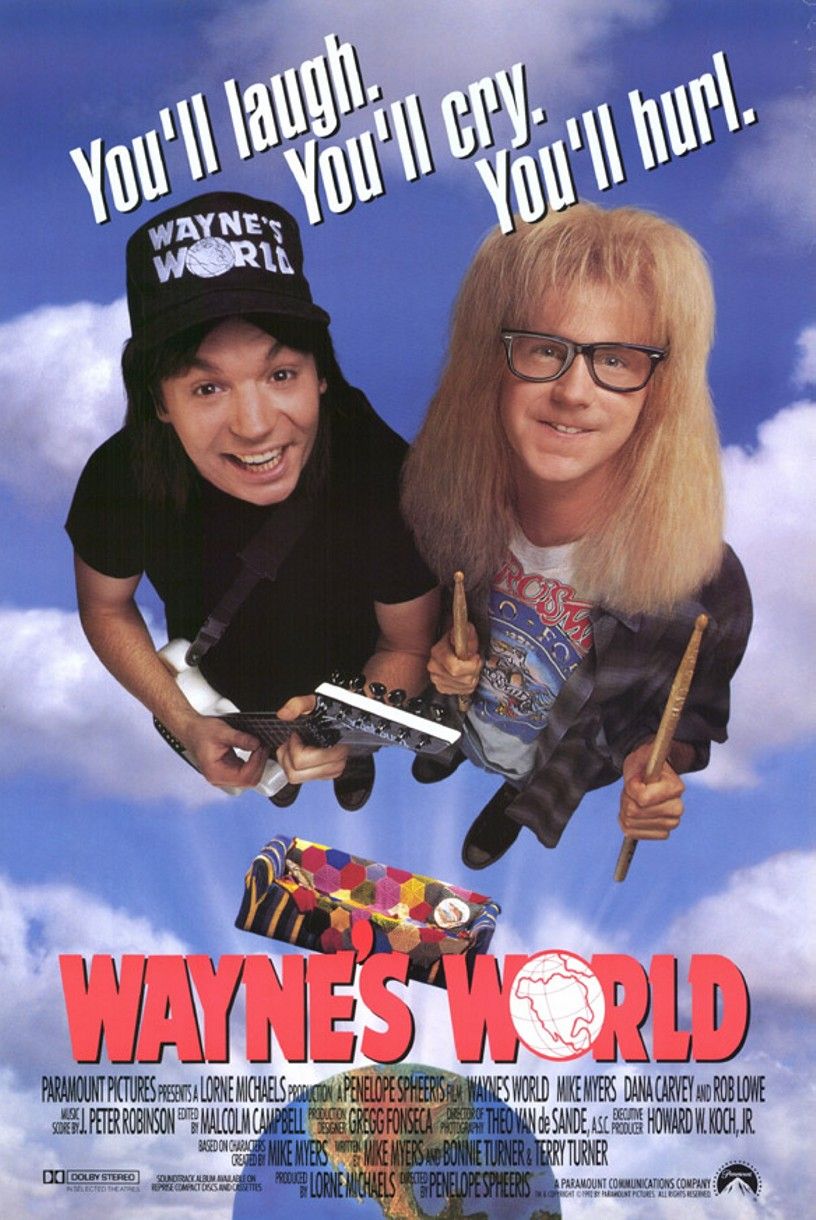
Believe it or not loyal reader(s?), there was a time when
the prospect of a Mike Myers comedy didn’t fill audiences with a collective
sense of dread. There was a time
when we used to sit on the edges of our seats, chewing our nails down to the
nub with eager anticipation for whatever comedic capering Mr. Myers was cooking
up his sleeve. Wayne’s World is a perfect example of
such a project. Endlessly
quotable, not afraid to take a dip into the warm springs of absurdity, and
featuring a game ensemble that possesses the rare of gift of seeming to be
making up the comedy as they go along, Wayne’s World stands alone. That this also came from a recurring
SNL sketch makes the accomplishment all the more remarkable. Perhaps time has been kind to Wayne’s
World in more than one way. The
most obvious being that it is genuinely funny and aside from the occasional
dated reference here and there (they actually are few and far between), the
humor is essentially timeless. The
second being that compared to the toxic-trash-burning-wasteland that is every
other SNL sketch-to-film adaptations, it is hard to disagree with Wayne’s World
being the “Citizen Kane” of SNL movies. Sure, Coneheads had its moments (on second thought, maybe it
didn’t), but Wayne’s World easily claims supremacy for its perfect distillation
of the cultural moment. At a time
when the carpet bagging of the alternative/”grunge” scene had reached its
saturation level in terms of mainstream domination, here comes Wayne’s World
warning of the dangers of corporate usurpation of public access television. I don’t think I’m grasping at straws
here because looking at the film’s box office gross; clearly it connected with
the general public. The fact that
it accomplished all this along with a throw-away reference to the movie
Scanners, a generous amount of screen time devoted to Ed O’Neil’s intensely personal
confessions of creepy and potentially threatening sentiments, and a police
officer obsessed with full body cavity searches makes this film a treasure to
be passed on from generation to generation.
Here we come to a tricky proposition. I’d be lying if I said I was the number
one Aladdin super fan. Hell, I’d be lying if I said I’ve even
seen Aladdin within the last seven years. I think I caught it on TV one random night a few years ago,
actually. The reason I am
including it in this blog is because it is the first movie I can remember that
produced tears of laughter from me. In another of my “someone needs to write a dissertation about
this incredibly useless subject” ideas, I propose that the ebb and flow of
Robin Williams’ career from Aladdin to Patch Adams would make for a fascinating
subject. If you were of a certain
age range when Aladdin came out, everything Robin Williams did was catnip for
your funny bone. Even a truly
wretched, cloying, and manipulative piece of garbage like Mrs. Doubtfire became
incredibly popular thanks to Mr. Williams’ antics (just ask Nate Carota). Upon writing that last sentence, it
occurred to me that a dissertation is not needed to trace the trajectory of Mr.
Williams’ career. He is only following in a long line of promising stand-up comedians
who eventually tumble down the “family film” rabbit hole, never to be seen
again. The reason I seem to be
stuck on an infinite loop of analysis and then dis-crediting the analysis of
Mr. Williams’ career is because his performance in Aladdin was revelatory to my
young eyes. All of it has kind of
become standard boilerplate for Mr. Williams and animation voice-overs in
general But! (Warning: I’m about to pull a fact straight out of my ass) I
believe this was one of the first “celebrity” voice-over performances in the
history of animation. The first
time that an actor in animation was asked to bring his previously established
cinematic personality into the life of a character. The Genie is what would happen if Robin Williams suddenly
morphed into an animated version of himself. From that point of view, it’s a fascinating and groundbreaking
performance. The argument can be
made that this was not necessarily a good thing. Animation was long the safe-haven for hard working,
relatively anonymous voice-over artists, who bust their ass for an art form
very few took seriously. Robin
Williams ushered in the era of lazy, paycheck cashing dub-work from a laundry
list of actors whose names I won’t bother to mention here. This is all a roundabout
way of saying that while I’ve retained little of Aladdin, (which I’m sure is
blasphemy to some of my Disneyphiile friends, sorry!). Robin Williams still makes me laugh my
ass of when I watch it. In
hindsight, maybe this is a poor excuse for a 365 entry. Then again, if I’m flipping around one
day in the near future and Aladdin pops on, you can bet your magic carpet I’ll
stick with it.
If you’re beginning to notice a pattern regarding my lack of
ability to catch first entries in movie trilogies, trust me, you’re not
alone. There isn’t any kind of
“sexy” reason behind this, save for the fact that I was probably far too young
to see the first Batman upon its original theatrical release. I do not regret this turn of events in
any way, shape, or form because Batman
Returns was, and remains my favorite Batman movie to date. Batman Returns contains one of the most
disturbing opening sequences ever for a child to see in a comic book movie. It begins innocently enough with a well-off
Gothamite family living out a fairy tale existence in their snow-covered mansion
of cavernous proportions. From
that point on, everything proceeds to fall completely the fuck apart with
tragic consequences. A baby is
born, it makes horrible squawking sounds from its crib, and it possesses a pair
of flippers instead of digits on its hand. So far, so fucked up.
It gets worse. The family reasons
that it can’t bear the thought of a mutant-flipper baby and proceeds to drop it
in the river as it sets sail for a new life in the comforting filth and waste
of the sewer. In what is perhaps
Mr. Burton’s most diabolical twist of all; he casts Pee-Wee Herman as the patriarch
of this cursed family. Allow me to
pepper a little context here into these next few sentences. Batman Returns was released in June of
1992. In July of 1991, Paul Reubens
was arrested for public masturbation in a movie theater in Florida. The point of all of this is to convey
the sheer mind-blowing power of seeing Pee-Wee-Herman in a movie at all, let
alone one where he plays a guy who drops his baby into the river. Granted, he
wasn’t paying Pee-Wee, but I can still remember the reveal of his characters
face as vividly as anything else in the movie. So if I may step out of that bit of contextual table setting
for a moment, the reason I have elaborated so specifically on the opening five
minutes of Batman Returns is because this is one miserable super-hero movie. If memory serves, Roger Ebert’s review
of the film finds tremendous fault in this attribute. I’ll have to respectfully disagree with Mr. Ebert because it
is for this fact that I find Batman Returns to be the most satisfying of the
entire series. Batman Returns is
the equivalent of a party populated by all of the weird, lonely, and
off-putting characters from Mr. Burton’s entire career. Only, the party sucks because the sense
of community just makes everybody feel worse. The characters in Batman Returns need to be in therapy
followed by heavy doses of medication.
The word downer doesn’t even come close to adequately describing the
grim specter of loss that cloaks this film. Desires are suppressed until they not only rot the insides of
the doomed individuals, but also destroy any chance of a genuine connection when
they are finally released. It’s
grim, but in Burton’s hands also genuinely thrilling and alive.