Tuesday, March 26, 2013

The Usual Suspects


365 Films

Entry #54

The Usual Suspects (1995)

Directed by Bryan Singer


I don’t have too much to say about Bryan Singer’s 1995 indie genre sensation, The Usual Suspects.  It is a film that has gained a certain amount of esteem in some circles while also garnering a very serious backlash in others.  I would say to those groups that you are both doing it wrong while planting my feet firmly in the non-committal middle.  Don’t get me wrong, it is ingeniously entertaining, the cast is exemplary from top to bottom, and the famous twist at the end while more satisfying in concept than it is in its schematic execution, does give the film a nice needed jolt of daring.  It is in those final moments that the complete vision of the film emerges from the smoky ruins and it is there that one might see more of a film school prank than a coherent vision.  As I said, you can skate by very easily on a high entertainment quotient.  What I will choose to focus on in this entry is the experience of seeing the film for the first time at the tender age of eleven.  This will be a question I pose to my beloved readers in that, do you think it’s necessarily shocking that an eleven year old might have walked out of this film thoroughly confused as to the meaning of the proceedings that just unspooled in front of him?  I only ask for a friend of mine…ah, who am I kidding, it was me.  I remember it so vividly, walking out of the theater and turning to a family member and asking: “so…what happened?”  Again, being the age that I was and the fact that the entire structure of the film seems to sort of beg this question to be asked makes this moment all the more unremarkable.  I only bring it up because it would become a habit of mine at much more embarrassing ages later in life when very obvious narrative twists would become diabolical moves in a game of eleventh dimensional chess that I was entirely ill-equipped to decipher.  That and I got distracted very easily sometimes during bad movies.  I now want to wrap this up by sharing some hometown Delaware lore with all of you.  Considering most of the people who read this blog are actually from Delaware, this may all be an exercise in futility but I will trudge forth nonetheless.  There was a theater in the Concord Mall shopping center known simply as the Concord Mall 2 and it is in this theater where we saw The Usual Suspects.  We also saw Pulp Fiction, Smoke Signals, Pecker, and Gremlins 2 for that matter, it was a theater that played any and all kinds of films.  To this day I never really got a grasp on what the objective of the place was, seeing as how it volleyed back and forth between the art house world and that of mainstream Hollywood cinema.  It’s just amazing to think there was a theater merely fifteen minutes away from the house where I grew up that was playing the shit only in available in the bigger, cooler cities.  It was all so accessible that I find it kind of mind boggling.  I have to say this theater played a large part in my growing appreciation for the medium.  Were it not for the easy access afforded by the Concord Mall 2, I’m sure dozens of titles on my favorites of all time lists would have easily slipped through the cracks.  To whoever owned and operated that theater for all those years, I offer you my sincerest gratitude from the very bottom of my heart.  I can’t remember the exact year it closed but it was a very devastating development for me.  The Best Buy that stands in its stead now has discarded any traces of that grand old movie palace that once was.  Where I was once making monumental cinematic discoveries people can now buy Catwoman, Jeepers Creepers 2, and Without a Paddle: Nature’s Calling at low, low, low prices.   


Sunday, March 24, 2013

Broken Arrow


365 Films

Entry #53

Broken Arrow (1996)

Directed by John Woo


Let me get one thing straight, I am by no means implying that Broken Arrow is John Woo’s best film.  It’s not even a very good film, largely devoid of the kind of personal thematic obsessions that run rampant in his Hong Kong filmmaking.  It’s an hour and forty-eight minute long live action cartoon blatantly ignoring any due diligence to the rules of logic or physics.  I’m sure there is a sub section of those reading this blog who would string me up just for the thought of putting Broken Arrow on here before Hard Boiled.  The best I can offer is I had never heard of director John Woo before this film and if it weren’t for the dedicated efforts of the HBO First Look team, I probably never would have.  The promotional material for the film, its trailers and whatnot did their best to hide Woo’s name but any blossoming cinephile could sniff it out on HBO or in the pages of Entertainment Weekly.  The making of showed clips from his earlier films where a man leapt into the air in slow motion while firing a shotgun at a motorcycle that caught fire and exploded from the impact.  It was like someone had scooped out the contents of my brain and run it through a projector at twenty-four frames per second.  I knew that whatever this “John Woo” was selling, I ought to be buying.  This was also back in the halcyon days of John Travolta’s second career as an energized character actor/movie star.  Re-entering the scene with Pulp Fiction, he had an indispensible amount of cache and funneled that into some promising prospects (and some not so promising ones, White Man’s Burden comes to mind).  Add the cherry on top in the form of screenwriter Graham Yost, (now of the great Justified-fame then of Speed-fame) and all signs indicated that this film had the necessary ingredients to be an unqualified success.  The key to most successful action films is pacing and the ingenuity of the action set pieces.  Following the Speed blue print, Broken Arrow is another perpetual motion machine that seems to be hurtling towards its finale and never takes itself too seriously.  The motivations and directives are simple and to the point, while Woo wastes very little time with draggy scenes of exposition.  It doesn’t hurt that a completely bugged out Travolta very easily walks away with the entire picture.  Where the film really shines is in the action sequences that combine the Peckinpah-meets-Gene Kelly choreography favored by Woo with a bright primary color palette that seems reminiscent of early the Looney Tunes cartoons.  Think of Travolta as the Coyote and Christian Slater as the Road Runner only with the Road Runner pursuing the Coyote and the Coyote in possession of a handful of nuclear warheads.  Okay, maybe the analogy completely falls apart but the fact remains that Woo’s innate skill with action and visual poetry blast Broken Arrow out of the realm of direct to video time waster and into that of intoxicating spectacle.  For me, the film is best remembered as a gateway drug into the highly addictive cinematic universe of John Woo and for that I will be forever grateful.  As ridiculous as it may sound, Broken Arrow heavily influenced the way I viewed action films going forward.  I realized that they no longer needed to be relegated to the labels of “junk” or “trash”.  Surely those labels will continue to rightly apply, but in the meantime there will always be filmmakers like Woo who aspire to do more, who aspire to make beauty out of the chaos. 


Saturday, March 23, 2013

A Skin Too Few: The Days of Nick Drake


365 Films

Entry #52

A Skin Too Few: The Days of Nick Drake (1973)

Directed by Jeroen Berkvens


My introduction to the music of Nick Drake came through the most pedestrian of means: as musical accompaniment to a Volkswagen commercial.  In my auditory ignorance, I remember mistaking Drake’s soulful baritone for that of Eddie Vedder’s.  When you’re young and obsessed with one particular musical act, everything begins to sound exactly like that, whether warranted or not.  As I was still not the least bit Internet savvy, I hesitated before properly reckoning with the Nick Drake catalogue.  Then came the appearance of Fly in Wes Anderson’s The Royal Tenenbaums and that seemed to all but clinch the deal for me.  The gorgeous melody, haunting vocals, and evocative guitar playing made the whole thing seem like a no brainer.  Through the wisdom of my sister, Tess, who immediately perceived a kinship between my musical tastes and Mr. Drakes music, I began consuming his musical catalogue at a ravenous pace.  Then came the painful moment for any Nick Drake fan when one learns that there would be no more albums after Pink Moon and that his own life was cut tragically short at the age of twenty-six.  This is all a way of introduction to the fact that several years later, my brother Nate and I were sitting in a tiny theater on east 12th street in Greenwich Village about to watch A Skin Too Few: The Days of Nick Drake, a documentary on the life of Nick Drake.  At forty-eight minutes, it barely qualifies as a feature; in fact I’m not even sure what the precise ruling is on this film.  The length, however, is perfect in its way in that the film reflects the compacted nature of Mr. Drake’s life.  Everything seemed to happen to him all at once and he could feel the entirety of living existence on a magnified scale and naturally, that state of being can’t sustain itself for very long.  The film itself does a lovely job of putting the viewer inside the headspace of its subject.  There are gorgeously rendered shots gliding and floating through Nick’s childhood home and subsequent resting place married to early demos of his music where one feels as though they are seeing the world, as Nick would have.  He was a ghostly apparition examining the world around him and expressing himself through the creations in his head, the only way he knew how.  Nick’s collaborators also get a decent say in his story and in one miraculous sequence, the demonstration of a track mix reveals the lengths to which Nick demonstrably inspired those around him.   So we are sitting in the theater and as the forty-eight minutes unspool in front of us, something remarkable occurs to me.  At the end of the film, Nick’s sister, Gabrielle (a woman who has worked tirelessly to preserve the legacy of her brother and mother) comments upon the cruel twist of fate that the source of Nick’s depression was that his music didn’t reach anybody or help anybody in his time.  I then realized that here we are, the group of us, sitting in this tiny theater in New York, watching a film about a musician from the other side of the world who was though to be long forgotten for over two decades.  Even the acclaim he has received now wouldn’t even dare to aspire to the level of adulation today’s pop stars.  There was no marketing blitz behind this movie, no million-dollar ad campaign, and nobody was here because somebody told him or her to be (then again, I’m sure a few people were dragged so take what I say with a grain of salt).  For the most part, everybody in that theater was there because they genuinely loved and have been touched by Nick Drake’s music.  His music accomplished exactly what he set out to do.  It’s a sad story any way you spin it, the only solace being now it has the best possible ending and it will continue for generations to come.       


Friday, March 22, 2013

Badlands


365 Films

Entry #51

Badlands (1973)

Directed by Terrence Malick


We are three weeks off from the April 12th release date of writer-director Terrence Malick’s new film, To The Wonder.  If you had told me fifteen years ago that I would only have to wait two years between Malick pictures, I would have punched you in the face and pushed you into oncoming traffic.  To kick off the celebration here at 365Films, I will do an entry each week (I’ll actually have to fudge it somewhat because I thought of this last minute) on every single title in Malick’s filmography.   Considering he has only five thus far, I should be able to squeeze every one in the allotted time.  I saw Badlands right around the end of the 20th century.  The very idea of filmmaking had been revolutionized for me with 1998’s The Thin Red Line, Malick’s first film in twenty years since Days of Heaven, and I wanted to see where it all began.  At first blush, I wasn’t as knocked out by Badlands as I was by Line.  For starters it’s a very odd movie, certain sequences have the most peculiar and leisurely pace to them and it goes out of its way to avoid every possible cliché of the lovers on the run genre.  Then I started to watch it again several years later in more public arenas and I realized that the film is the closest Malick will ever come in his directorial efforts to an out and out comedy.  The disconnect between what the characters are actually doing versus what they say and think they are doing leads to several hilarious observations on Malick’s part.  An example of this is when Kit and Holly are driving away from Cato’s farm where Kit shot and killed his friend and possibly killed a couple after forcing them into a storm cellar.  They drive by a nearly over turned, beat up car on the side of the road and Kit points out: “Hey, look.  They’re probably gonna blame that on me too.  Bastards.”  The idea is that Kit has just killed as many as seven people yet, in his mind, he has the temerity to act as if this situation has been hoisted upon him and he is blameless for his actions.  On top of that, he feels nothing but contempt for the authorities that are after him when there is nothing but flat, empty, and wide-open space surrounding him and Holly.  That’s just a small example of a beguilingly rich film abundant with moments just like that.  Instances of cinematic life that effortlessly glides between comedy, drama, and tragedy but even that sounds too simplistic a summation.  I tend to get tongue tied when trying to break down what it is about Malick’s cinematic universe that pulls me into it every time.  He is, for me, the most indescribable of great American directors.  I know exactly what it is that I’m watching but damned if I’d be able to articulate to someone why it is that way.  The best I can do I say his technique here is an exacting method of wandering philosophical observation combined with a genuine love of the natural world that is honest enough to never dip into phony sentiment.  Badlands is a story about two children pretending to be outlaws in a world where their violent actions are met with more of a puzzled indifference than out and out disgust.  It is, at first glance, a scaled down version of Malick.  The conflicting argument could also be made (not by me) that this is perhaps the purest and most successful distillation of his gifts.  That it is free from all the poetic ruminations that have become more and more prevalent in his style since then.  However you look at it, Badlands to this day is a film like no other.  And if you are patient and cooperative with its rhythms, the rewards will pay off exponentially every time you sit down to watch it.  It is simply put, a masterpiece. 


Thursday, March 21, 2013

Toy Story


365 Films

Entry #50

Toy Story (1995)

Directed by John Lasseter


And now for the lighter side of things, which is funny, because the Toy Story films would only get substantially darker and bleaker as the series went on.  However, the introductory film remains one of the loveliest ever made.  Computer Graphics had already made their big splash several years prior with The Abyss, T2, and Jurassic Park but something about Toy Story felt special to me.  I’m sure a real film historian would slap me across the face for writing this but seeing the film for the first time is as close as my generation will come to seeing color film for the first time or sync sound.  It was like discovering a brand new medium and all the incredible possibilities that dwelled within it.  It’s considerably telling that Toy Story’s main thematic concern is a flashy, new tricked out toy replacing the tried and true faithful cowboy pull string doll.  Buzz is Pixar and Woody is traditional hand drawn animation and in the films utopian view of society they learn to co-exist and get equal attention as part of the cornucopia of wonders that live in Andy’s room.  At the same time there is a simplicity to the film that is so damn refreshing when compared to today’s current crop of animated, over-achieving crap piles.  This was six years before the Shrek revolution when Dreamworks heralded in the age of ironic winking and pop culture grasping replacing actual story telling.  Toy Story almost looks quaint by today’s standards and to think that when it was released, it was considered revolutionary.  It definitely was that, especially by the ever-decreasing standards of what passes for “kids movies.”   One might be noticing a trend here in that I take the utmost offense at lousy films aimed at children and young adults.  Seriously, that shit needs to stop.  Where was I? Oh right, taking a cue from Pixar’s guardian angel and inspiration, Hayao Miyazaki, Toy Story luxuriates in its setting and feels no need to plow thoughtlessly into its plot.  It may not have Miyazaki’s wonderful eccentricities, but they’ve definitely got his pace down cold.  This is a film that could have very easily turned into a seventy seven minute advertisement for all those entertaining Mattel products (to use just one example) and the fact that the filmmakers took those brands and created their own painfully unique and human characters out of them is a testament to their talents.  If you’ll jump ahead with me sixteen years later as I’m sitting in a theater with Nate about to watch the slightly dull but beautiful Cars 2 (it’s really not that bed, get over it everybody) when the short film that precedes all Pixar films comes on screen.  It’s a Toy Story short and as pathetic as it sounds, I am so happy to see these characters again.  Did I have any idea back in 1995 that I would spend the next sixteen years growing up with these characters?  And be utterly delighted just to see them again no matter what the context? No. But I really, really hoped I would be.  Toy Story is the kind of film that makes you want to have kids, if for no other reason than to pass films like this onto them.  Just to be clear, I said that is the ONLY reason to ever have kids.  I hope nobody misunderstood me on that one. 


Se7en


365 Films

Entry #49

Se7en (1995)

Directed by David Fincher


David Fincher’s Se7en is one of the most pessimistic, misanthropic, and just flat out uncontrollably bleak films ever made.  The fact that is grossed well over three hundred million dollars speaks volumes about the fragility of the American psyche.  I guess we, as a nation, sometimes just want to feel like shit.  Perhaps this is why I have revisited the film as infrequently as I have over the years; it’s a deeply unpleasant experience.  I first saw Se7en when I was eleven years old on its opening weekend in 1995.  I had some familiarity with the serial killer genre and the trailers and marketing certainly promised a more black and white affair.  I was certain going in that the bad guys would be caught and punished and the forces of good would restore order to the universe like they were always destined to.  I used to have this strange habit of critiquing action movies wherein if the villain died what I deemed to be a “cool death”, it could redeem the entire project.  Speed is not a good example because that is a great film, but it has an awesome beheading death for Dennis Hopper at the end (spoilers!)  Desperado is a film, for example, that let me down in this department.  There’s a whole mess of high octane, beautifully choreographed mayhem for the first one hundred minutes and then it resolves himself by the villain just getting shot like any other schlemiel.  Anyway, Se7en was the first ending I saw where the villain gets a pretty decent death (shot in the head at close range, which over came my objection to a bad guy just getting shot, I know, I know, I’m not proud of my ten year old self either), and yet, I felt a strange emptiness inside.  This was not a triumphant death by any stretch of the imagination and the limited exposure I’ve had to the film since then indicates that it is ultimately the hero who is dealt the lethal death blow.  A cold hard fact of reality is that in real life (unlike movies) when you shoot an unarmed suspect at point blank range there may be some legal consequences headed your way.  That is Se7en in a nut shell: it tempts you with the promise of trashy genre material and then proceeds to pull the rug out from under you in the most brutal possible fashion.  Fincher is no sadist mind you, more of a morose observant carefully detailing the pointless folly of good trying to triumph in the world as twisted as this one.  I know that sounds like a bummer and this movie definitely is, but Fincher pulls off an admirable feat by making it sickeningly watchable.  As a charming post script to the story of my first encounter with Se7en, the night I saw it I threw up and my sister had a terrible nightmare.  It’s very possible that I have those events in reverse and I had the nightmare and my sister got sick from watching it.  In any event, the point is very clear: this movie will fuck you up.      


Tuesday, March 19, 2013

Before Sunset


365 Films

Entry #48

Before Sunset (2004)

Directed by Richard Linklater


One of the many ingenious concepts driving Before Sunset is the idea that the film prior to it stands as a stain upon the memories of the two main characters.  It’s not to say the point is made that Jesse and Celine look back on that time with contempt but rather regret in holding up the experiences of Before Sunrise as the pinnacle of their lives.  Any concept of a sequel to that film would have been disastrous if they had attempted something like that.  For example, had they executed a simple rehash bathed in nostalgia and self-satisfaction for the simple chore of reassembling the old team for one last go-round, the results would have been depressingly banal.  The first of many things that Linklater, Delpy, and Hawke made sure of was the fact that they allowed an actual amount of time to pass.  Nine years stands between these two films and it’s almost embarrassing to imagine what would have happened had they shot the film a year or two later and merely pretended that much time had passed.  Just look at the way the two actors carry themselves and the way they listen during conversation, these are two completely different people to whom nine years has made a remarkable difference.  The way Linklater plays with time and pacing in this film is especially interesting in comparison to its predecessor.  The original film runs merely one hour and forty minutes, and while it’s by no means an epic it allows you to feel the entirety of a night without shooting a twelve-hour film.  Sunset runs a scant eighty minutes and it is shot in real time.  Jesse is on his way to catch his plane back to the states so the film even has a ticking clock element to it as well.  In their early twenties, everything was happening to these two and they wanted to experience it all and make the most out of that borrowed time as much as they could.  Their thirty-year-old selves on the other hand are running out of it, even the title of this film itself is indicative of a finite amount of time.  This is all a way of getting at what is most remarkable about this film is the fact that Linklater chose to take his characters to dark and mournful places and allow life to happen to them.  This is a film about reconnecting, mourning over what’s been lost, and finally attempting to get on with it.  That the two actors still maintain their warm rapport and Linklater’s skills as a visual stylist have increased exponentially in nine years only makes that bitter pill so incredibly easy to swallow.  This is romantic comedy as thriller and the “will they or won’t they” aspect is a race against not only that nagging flight back to the states, but also against the very idea of time itself.  Speaking of the will they or won’t they, Before Sunset has to have one of the boldest and most satisfying final shots of any film in recent memory.  It is also the moment in my life when I was introduced to the incomparable Nina Simone and for that I will be eternally grateful.  It is my understanding that Linklater has been shooting a film for the past twelve or so years that is to center around the real age progression of a child from boyhood to adolescence.  Obviously I will be there front and center for that film when it is released but part of me can’t help that feel that Linklater has already accomplished showing life on film in real time.  With Before Sunset, Linklater has created a new genre: romantic comedy as life itself. 


Before Sunrise


365 Films

Entry #47

Before Sunrise (1995)

Directed by Richard Linklater


Richard Linklater’s Before Sunrise appears to have become as much of an aberration as the central duo’s coupling that the film depicts.  The film begins as a conversation on a train between two strangers and (as in the ensuing story and its follow up, Before Sunrise, followed by the soon to be released Before Midnight), manages to be about the entirety of life itself.  In typical Linklater style these ideas are communicated through speech and body language instead of the typical cinematic tools to which we have become too easily accustomed.  What’s fascinating about Before Sunrise is the way in which Linklater combines a screenplay predicated entirely on dialogue with a purely observational aesthetic technique.  Which is to say, this very well could be a play but at the same time would lose something were it not cinema.  Ignoring the obvious loss of the Vienna locations in making this story stage bound, I noticed something in revisiting the film that I also feel lends it a totally unique cinematic quality.  The film is not just about what Jesse and Celine say to each other but how they say it and perhaps equally important, what they choose not to say to each other.  One example is a great little moment early in the film when the two are riding a Vienna street car and each is asking the other about their lives.  Hawke does this thing where he attempts to wipe away a few strands of hair from Delpy’s face only to have her turn at the very last minute and make the adjustment herself.  He then spends the rest of the conversation doing everything he can to ignore the overwhelming attraction he feels towards her.  He looks out the window, he tries a little too hard to make eye contact, and he tries his best to make sure she knows he’s listening.  It’s almost as if he has revealed his true self to her in that moment, and his true self is unspeakably in love with her.  In thinking about the rest of Linklater’s work while revisiting Before Sunrise, it has become apparent that an ongoing theme running throughout everything he has done is that of the idealized-self coming into contact with the actual self.  The characters in Linklater’s films are always trying to be or thinking about being their best, but find that the great difficulty of life is putting that into practice.  In Before Sunrise, much is made of how the two leads are acting on borrowed time.  That their chance encounter was never supposed to happen, therefore the night they have together isn’t really happening.  This allows them to treat this freak occurrence in nature with zest and aplomb.  They can be whomever they want in these intervening hours and they can be to each other whomever they want to be as well.  It’s an interesting parallel with how relationships work in that when you meet someone new, it’s almost as if you get a chance to freeze time and assess your life up to that point.  Your partner is not only an impartial observer but also a patient listener.  And really, what more is there to talk about than your past?  It’s how we learn, how we grow, and how we figure out which steps to take for our future.  Before Sunrise makes the point that only by accepting the fact that our true selves are amorphous, combustible, and susceptible to change can we ever really figure out what those true selves were in the first place.


Sunday, March 17, 2013

The Hudsucker Proxy


365 Films

Entry #46

The Hudsucker Proxy (1994)

Directed by Joel Coen


The Coen Brothers seem to take an inordinate amount of pleasure out of subverting the expectations of even their most ardent fans.  After the academy award winning triumph of Fargo, they followed it up with the stoner-bowling-Chandler-LA love letter, The Big Lebowski.  After the grim, hard-bitten neo noir of No Country For Old Men came the bugged out live-action cartoon spy satire, Burn After Reading.  Their 1994 bomb, The Hudsucker Proxy quite neatly fits into this trend by following perhaps the most abstract and heady effort of their career, Barton Fink.  The key words to note in Barton, Fargo, and No Country are award winning.  Every time the boys get heaped with a whole lot of praise, they find a way to churn out a follow up that only a handful of people could love or even see.  Such is the reputation that Hudsucker has been unfairly saddled with: an inferior follow up.  Not only is the film the biggest box office dud the duo has ever produced (don’t quote me on that, I’m not entirely sure I just don’t feel like looking it up…yeah, you heard me) it also ranks fairly low in critic respectability rankings (although I’m not sure how official these rankings are).  I think time has been kind to the film and when the unfair burden of expectation has been lifted, Hudsucker reveals itself to be one of their most accessible and charming productions to date.  Digging deep into the well of Preston Sturges, Howard Hawks, Frank Capra, and even the Warner Bros cartoon collection proves to be a comfortable fit for the Coen brothers.  Although at times the seams show when the pastiche is trying a little bit TOO hard-Jennifer Jason Leigh’s performance is a culprit here, she gives it her all but the character never quite rises above the Rosalind Russell imitation it so intensely strives for.  And the sagely yet too magical black janitor Moses seems like an import from the past that had long since reached its expiration date (but don’t get me wrong, I love Bill Cobbs).  That being said the film is a marvel of art deco influenced production design and instantly quotable screwball dialogue.  The casting of Tim Robbins as the imbecile with the hearth of gold Norville Barnes makes good on the promise of Robbins’ lanky frame as a physical comedian.  Sterling supporting performances abound and as previously stated, even if the Jennifer Jason Leigh thing never quite comes together she does have some marvelously choreographed verbal jousts with her male counterparts.  Her scenes battling the editor and a colleague at the newspaper have a particularly zany sting.  Films like this are damn near impossible to pull off, just look at George Clooney’s 2008 dud, Leatherheads for proof.  The screwball comedies of the 30’s and 40’s have a time capsule quality that makes any attempt to recreate it for a modern era just seem like a desperate plea for nostalgia.  By burrowing so deep into their influences, however, the Coen brothers reached a sort of infinite loop of the original and homage.  The DNA of their filmmaking breeds so effortlessly with that of the era in which they are frolicking that you can’t tell where one ends and the other begins.  Committing to that kind of dedication in the execution and making it look so effortless is as fascinating to watch as that damn hula-hoop swinging around the kids hips, damn near as strange too. Now let me ask you a question: Would an imbecile come up with that?  


Gattaca


365 Films

Entry #45

Gattaca (1997)

Directed by Andrew Niccol


One of the most under appreciated films of the 90’s, Gattaca stands out as a vivid example of what science fiction can achieve in the visual medium.  Stylistic without being distractingly so, and executing a vision of the “not to distant” future, which is extraordinary in its timelessness, Gattaca is the kind of sci-fi long thought to have vanished.  The textures, colors, and design of the film are a marvel to behold.  All the more so considering it was shot on a shoestring compared to its equivalents in the genre.  The accomplishment is even more astounding when taken into account that this was writer-director Andrew Niccol’s first feature film.  His was a career that began with two flawless gems (he was also the writer of The Truman Show) and now has him directing adaptations of Stephenie Meyer books.  Gattaca remains his sole directorial triumph with the Nicolas Cage vehicle Lord of War coming in second as a crazily ambitious yet wildly uneven runner up.  Not to start a dog pile on the guy but watching the progression of his career has been all the more frustrating because of the startling vision he presented in Gattaca.  The film has such a haunting, lyrical quality to it that in watching it again recently, part of me thinks that the science fiction elements are just as much a MacGuffin as the murder subplot.  A subplot, which, by the way, is, so casually dismissed that a new term needs to be invented for its irrelevant mis-direction.  “Sub-MacGuffan?” “Super MacGuffan?” I’m just spit balling here.  That’s not to say the science of it is irrelevant and I should add Niccol displays a preternatural ability to convey information about an alternate reality without getting bogged down in exposition.  That part of the film is wonderfully thought out and exquisitely conceived.  The thematic aspects of the film that interest me these days are in the funereal tone that seems to be slathered all over the film.  Gattaca the place could very easily be swapped out for Hollywood or any other dream factory where the majority of those dreams are made outside with noses pressed up against glass.  The idea of being deemed from birth to be an unfit member of the world could be swapped out with the generation after generation of societal prejudice laid at the feet of so many human beings.  Jude Law and Ethan Hawke’s perfect performances reinforce this metaphorical through line.  For the duration of the story, these two act as mirrors, opposites, and towards the end, points of aspiration for each other.  The fact that life has given everything it promised for Hawke’s character and nothing of the sort for Law’s point to a worldview indicating that we are at once in control and out of control of our ultimate destinies.  In life we will always come up against thwarted ambitions and the lousy hands we are sometimes dealt, but it is our choice to either keep looking up at the sky or to become engulfed by the flames.  In Niccol’s vision, the key word in that sentence is choice.  


Friday, March 15, 2013

Clear and Present Danger


365 Films

Entry #44

Clear and Present Danger (1994)

Directed by Phillip Noyce


I can’t say I’ve spent a lot of time thinking about Clear and Present Danger.  It’s a political thriller from 1994 that contains some of the nutty, right wing hysteria inherent in Tom Clancy literature mixed with the nutty, paranoid worldview of screenwriter John Milius.  Mix in the political conscience of Schindler’s List screenwriter Steve Zaillian and you have an incredibly satisfying, if childish, cinematic iteration of our disastrous yet action packed U.S. foreign policy.

I think that’s really all one can say.  It's best to let the film speak for itself. 

Oh, and this…


Thursday, March 14, 2013

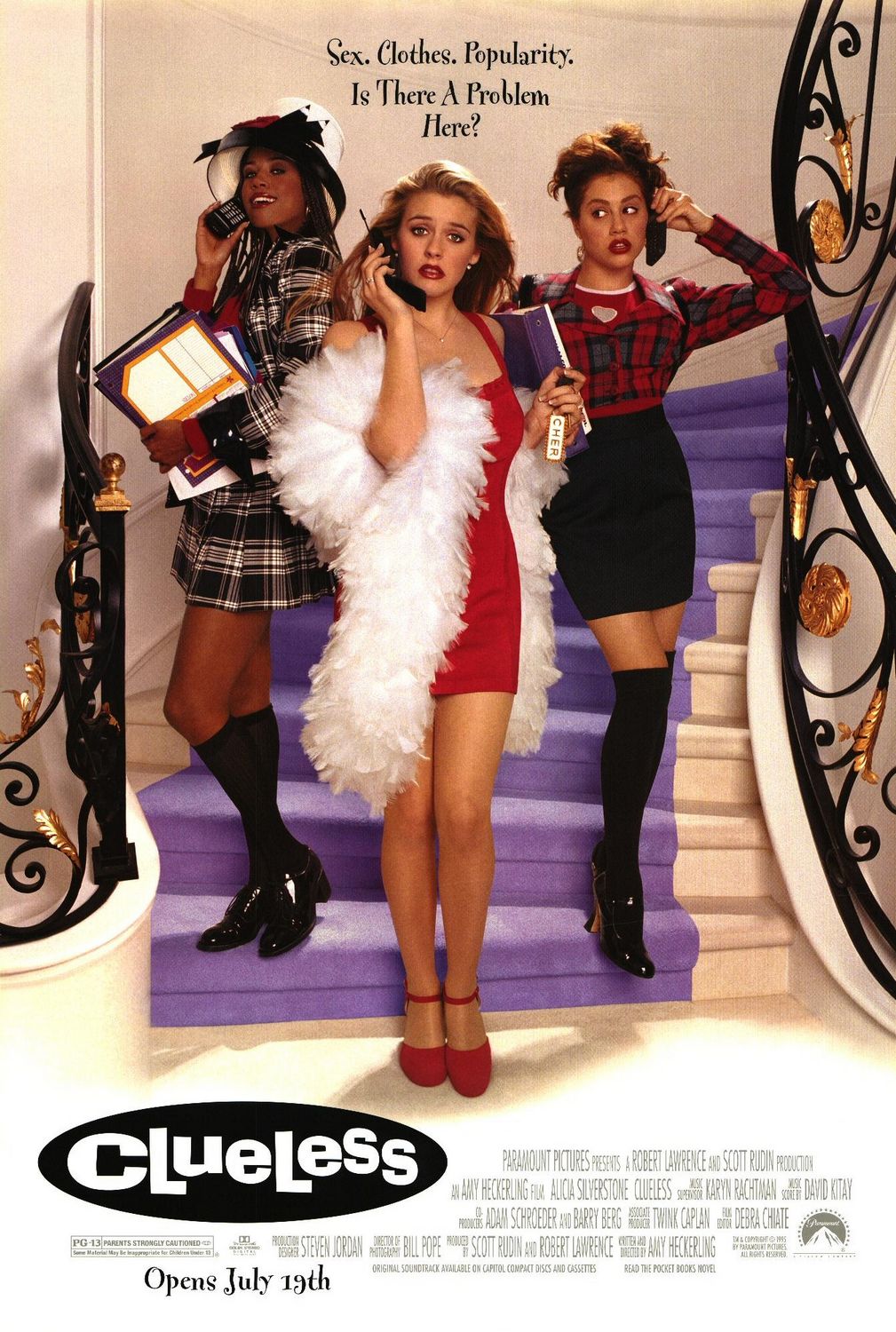
Clueless


365 Films

Entry #42

Clueless (1995)

Directed by Amy Heckerling


Six years ago I was interning for an undisclosed production company on the Sony lot and we were visiting the set of a big Hollywood picture that was just about to wrap.  The scene in particular being filmed was none too interesting, however we still stood in rapt attention due to the participation of several of the film’s key players.  Among them were one of its stars, its director, and most important to this story: the cinematographer.  As I gazed in wonderment at the director in question, my female co-workers were all breathlessly pointing out the presence of the DP.  “Bill Pope, oh my god, it’s Bill Pope!!!”  I turned around, thinking I had the answer for my star struck friends.  “Yeah, he shot The Matrix, right?”  Their come back was as passionate as it was immediate.  “No! He shot Clueless!!! DUH!!!”  I pulled out a granola bar and retreated back to my corner and meekly stated, “I withdraw my question.”  It was at this point that I knew Clueless as a movie had survived and maintained a legacy.  Soon after that I bought the DVD and finally realized exactly what they were talking about.  Clueless was a film that I’ve always appreciated and have only recently come to love.  I saw it when I was eleven and as embarrassing as it is to admit now, I was much more taken with the previous month’s release of Congo.  I’m sorry but the girl from those Aerosmith videos had nothing on a talking gorilla that drank martinis and jumped out of airplanes.  I don’t want to get on a whole tangent here but seriously, somebody needs to write a graduate thesis paper on Congo, for it is some kind of warped masterpiece.  Anyway, as the years went by I started to appreciate the subtle humanity that writer/director Amy Heckerling brings to her characters and in particular, the adult characters.  The parents and teachers in this film are not treated like the absent-minded; rap lyric quoting buffoons most teen movies reduce them to.  This generosity of spirit extends to the rest of the cast as well.  All of them might not be perfect (I’m looking at you, Elton) but in keeping with the fluidity of the teenage personality complex, they all reveal themselves to be more than we initially thought.  When Cher has to reassess the damage her oblivious personality has wrought, she finally comes to the realization that the world is not a film in which she is the protagonist.  Everybody in her life has a story and they all have their reasons.  And it is in this decision to give herself over to a larger idea of humanity that she is able to find any kind of stable happiness.  That Miss Heckerling is able to introduce these kinds of ideas into a film populated by characters that a lesser filmmaker would take pleasure in glibly mocking is just one of its many revolutionary traits.  I feel I must also acknowledge the films legacy as my personal introduction to the city and culture of Los Angeles.  Needless to say its virtues in this department definitely revealed themselves more thoroughly when I actually moved out here.  Nevertheless, in thinking back to that opening weekend in 1995, the film remains as fresh today as it did almost eighteen years ago.  It’s an exemplary teen movie and a refreshing example of a mind-meld between pop culture and cinema. Bill Pope indeed.