Sunday, February 24, 2013

Philadelphia


365 Films

Entry #25

Philadelphia (1993)

Directed by: Jonathan Demme


Jonathan Demme’s Philadelphia is another one to add in the devastating childhood trauma bin of my early cinephile memories.  I remember openly weeping in my bedroom at the end of the tape.  To prove what an unadventurous moviegoer I was at that age, Philadelphia (like Schindler’s List) only came to my attention when Tom Hanks won the Best Actor Oscar in 1994 ‘s Forrest Gump.  I had an additional vague interest in the film because it was named after a city I was familiar with on a proximity basis and because I remember folking out to the Bruce Springsteen song, Streets of Philadelphia.  The funny thing about that is the Neil Young song Philadelphia is actually more of a punch to gut than the Springsteen song.  When it rains, it pours, I guess.  All of this contributed to a completely devastated ten-year-old psyche.  A wound that was incredibly painful due to the fact that I had just sat through the slow and agonizing death of that incredibly nice man from Big.  Tom Hanks was not Tom Hanks yet to me so all I had to associate him with was the fun-loving hijinks of the aforementioned Josh Baskin.  I was already quite smitten with Denzel Washington from Malcolm X so I had absolutely no problem with watching him play the heroic lawyer.  The point I’m trying to make here is that when you’re young, you are burdened and gifted with an inability to care about or acknowledge the real life personalities of your favorite actors.  All you had to go on was their films.  Granted, Mr. Washington and Mr. Hanks were never two to seek out the tabloid spotlight, but even if they had, I wouldn’t have known about it.  Therefore it becomes difficult to separate them from the characters they play.  You, the viewer, bring the off-screen baggage of associating them with past roles and that can either work to their advantage or disadvantage.  In this case, it was an advantage, but it also inhibits you from seeing them stray too far from their established personas.  Philadelphia was where I learned I had to separate an actor from his or her previous characters in order to truly appreciate their craft.  As painful as it was, it had to be done.  This could also be known as the “Macauly-Culkin-Dies-At-The-End-Of-My Girl” phenomenon.  Maybe that’s why movies have such a powerful hold on us.  They reduce us to blubbering children, utterly baffled as to why the person they thought was our friend betrayed us by dying or acting like a villain at the end.  That probably doesn’t make any sense, but it seemed like a good way to close out this particular entry.  If anyone wants to re-visit Philadelphia and let me know if it is as devastating as I remember it to be, I’m game.  


Saturday, February 23, 2013

Hot Shots: Part Deux


365 Films

Entry #24

Hot Shots! Part Deux (1993)

Directed by: Jim Abrahams


There isn’t anything to say about this movie that I didn’t already say in the Naked Gun 2 ½ entry.  Call it a cop-out if you like but I would like to use this opportunity for all of us to bask in the Hot Shots series warm glowing warming glow.  Oh, and to exalt the comedic genius of Lloyd Bridges.  You are dearly missed, sir.


And some OG Hot Shots thrown in for good measure


And Siskel and Ebert’s scarily prescient take on the state of American comedy and its future. 

Friday, February 22, 2013

Demolition Man


365 Films

Entry #23

Demolition Man (1993)

Directed by: Marco Brambilla


I will attempt to unpack the cultural force that is Demolition Man with a personal anecdote.  I’m visiting my sister in the winter of 2009.  I arrive at Penn Station and hop on the subway to get to her apartment in Brooklyn.  I’m on the train, minding my own business and keeping to myself as per usual.  I’m traveling with my backpack and travel bag.  Flashback about three years prior to the set of Nathaniel Carota’s A Slow Dissolve in Ketchum, Idaho where I’m busting my ass while the assistant cameraman (for privacy’s sake let’s call him Gabe F. No, that’s too obvious…G. Fonseca) sits around doing absolutely nothing (as was his habit).  In our spare time G. Fonseca and I had come up with a hypothetical sequel to Demolition Man titled Demolition Man 2: Phoenix Rising.  Mr. Fonseca then attempted to write that particular title on a piece of camera tape and attach it to the slate of the film we were currently shooting.  We all had a good laugh even though I didn’t quite understand it.  But I stuck that piece of tape to my backpack as inspiration to get off my ass and make the Demolition Man we’d spent at least 10 minutes dreaming about.  Back to winter of ’09 on the NYC subway, when an unkempt youngster approaches me on the platform as we are both heading for the stairs.  “Hey, that thing on your backpack, is that real?” I reply, “No it was just a joke between my friend and I.” With a hopeful look on his face, the guy says “Oh. That’s too bad because I got really excited for a second when I thought they were actually making that movie.”  Did I mention that this was one of several random conversations I’ve had with complete strangers about our shared desire for a Demolition Man 2?  I rest my case.  Demolition Man is here and it’s here to stay.  If you thought this was a long forgotten, destined to reign as king of the dustbin in the bottom shelf of the TBS library title, then you thought WRONG my friend.  Demolition Man boasts endless re-watch value, so much so that it somehow manages to be both better and worse than you had previously thought with each subsequent viewing.  That is no small feat.  It features what is perhaps the greatest Wesley Snipes performance in the history of cinema (also no small feat).  And a vision of the future and Los Angeles that is both prescient, yet bathed in the nostalgia for the time in which it was made.  Demolition Man, in a lot of ways, is the ultimate 90’s movie.  It’s a movie in which a violent dinosaur like Stallone (who was on his way out career-wise back then…or so we thought), validates his existence and proves the need for the Joel Silver/Jerry Bruckheimer mega productions of the late 80’s early 90’s.  In its gently insidious way, Demolition Man reinforces the idea that not only do you need to watch this movie for entertainment value but that you need to watch it for the future of the human race.  If you don’t, than all we have to look forward to is Rob Schneider’s constant mockery at your inability to use the three sea shells.  If that isn’t a grim prognostication, I don’t know what is.  I will also take this time to admonish you all to read the Demolition Man novelization by Robert Tine.  I read it before I saw the movie because I could not find a suitable chaperone to accompany me when it was in theaters.  If any of you have seen The Simpsons episode where Bart is forbidden from seeing the Itchy and Scratchy movie, so he instead reads the entirety of the Norman Mailer novelization: that’s exactly what it was like. 


Thursday, February 21, 2013

A Bronx Tale


365 Films

Entry #22

A Bronx Tale (1993)

Directed by: Robert DeNiro


A Bronx Tale, Robert DeNiro’s directorial debut, concerns the coming of age and subsequent battle for the soul of one Calogero Anello.  The two opposing forces are the boy’s father Lorenzo and the local crime boss Sonny.  As Caloegero navigates the tricky tight rope between a law-abiding life and that of a hoodlum, a larger portrait of the Bronx in 1960s emerges.  A Bronx Tale originated as a one-man show created by Chazz Palmenteri (who also plays Sonny in the film).  In the transition from stage to screen the film wound up in the directorial hands of Robert DeNiro (who plays Lorenzo in the film).  I offer this bit of back-story to you now because none of it made a damn bit of sense to me when I watched the movie from beginning to end on its HBO Saturday night premiere.  In collecting my thoughts about A Bronx Tale, I began to feel a deep nostalgic longing for the HBO Saturday night movie.  Creating a legacy of quality the network has long since abandoned (this years premieres included The Three Stooges, Battleship, Project X, the list goes on and on…), the Saturday night movie offered me the window into a world of film outside of the multiplex.  Don’t get me wrong, they showed a lot of crap, but films like A Bronx Tale made the indelible impression upon me that Cliffhanger wasn’t the only option at the video store anymore.   Again, none of this mattered when I switched on the TV at eight o’clock on whatever long ago Saturday night that happened to be.  It’s possible that pure chance and coincidence drew to me to this film.  The funny thing is, there is one dialogue exchange in the film that I remember in exact detail.  The scene in question is when Sonny teaches Calogero about the door test.  The door test involves determining whether a potential date is right for you by observing if she reaches over to open the driver door in your car after you have opened the passenger door for her.  Why this patriarchal and antiquated ritual stuck with me for all these years I have no idea, but that’s literally all I remember.  Even the bare bones plot description I provided came from the wikipedia summary.  You might ask why in god’s name did you pick this film to write about for your 365 blog?  I have no conclusive answer for this.  I don’t remember the film at all but I remember how it served as an introduction to the acting titan known as Robert DeNiro.  I remember the tragic inevitability of the ending and how that shaped my view of the mob sagas I would consume ravenously in the coming years.  A Bronx Tale was where I started to connect the dots between the content on screen and the personality of the creators behind the scenes.  Even if I don’t remember the specifics, I will be forever grateful to it for that.   


Wednesday, February 20, 2013

The Fugitive


365 Films

Entry #21

The Fugitive (1993)

Directed by: Andrew Davis


When I selected The Fugitive for this blog, I never thought about how I would eventually tackle it.  On the surface there’s nothing that remarkable embedded in my memories of it.  It’s not a film that has inspired any kind of controversial re-interpretation in the intervening years.  For lack of a better expression, it is what it is.  Then I thought about it some more and in a way, that’s kind of marvelous.  It’s fair to say that I’ve become fairly disillusioned with the state of modern actions films.  What passes for action these days is usually infested with superheroes, Jason Statham, or starring a bunch of old dinosaurs from the 80’s with Jason Statham for support.  Since we’re on the subject, I feel that I have given a pretty fair shake to Mr. Statham and his films and the only thing I can come up with is: this is the best we can do?  Getting back to the matter at hand, the years have been very kind to The Fugitive.  It has an endearing no-nonsense quality about the action and story.  The direction by Andrew Davis, while always spot-on, never distracts with that stab-you-in-the-face assaultive approach to cinema that seems to have taken over Hollywood.  We seem to have lost our patience for the workman approach to action filmmaking designated by the likes of Mr. Davis, John McTiernan, or Wolfgang Petersen.  The train/bus crash escape sequence alone is an incredible action set piece.  Filled with dynamic sudden twists of luck and an escalating sense of exhilarating danger from otherwise ordinary means of public transportation.  It’s a showstopper in the best sense of the word.  This was certainly one of my first acknowledgements of what a “set-piece” was in an action movie.  I can’t think of a better film to introduce me to this incredibly rewarding cinematic practice.  But before I fall into that trap of bemoaning the loss of how things “used to be”, I will point out that The Fugitive certainly had its moment in the sun.  It was nominated for seven academy awards, winning supporting actor for Tommy Lee Jones.  It also dominated the pop-culture landscape from the year it was released to the end of the decade.  I can think of at least several different Simpsons parodies right off the top of my head.   I think all of that is a testament to what a well crafted, ingeniously devised, and character heavy action movie can accomplish when given the right amount of care.  It is entirely possible that this kind of movie can have a new renaissance in our day and age.  We just have to demand it.  


Tuesday, February 19, 2013

Cliffhanger


365 Films

Entry #20

Cliffhanger (1993)

Directed by: Renny Harlin


I’ll try to make this short and sweet because I really don’t have that much to say about Renny Harlin and Sylvester Stallone’s mountain climber-rescue-action movie Cliffhanger.  I don’t mean to disparage the film but this is definitely one of those entries wherein the entire concept of doing this blog in the first place backfires.  I’m including it because if I wish to present the entirety of my cinematic education, I have to show it as it happened, the warts and all truth.  When you are an aspiring, young cinephile, the most treasured of all your possessions is your family’s video-store rental membership card.  It’s astonishing that in such a short amount of time those elusive, idol-like objects have all but gone extinct.  My point is that when you rely on the video store as heavily as my family did, you tend to get lazy in your selections.  Why would I want to explore and seek out new and interesting directors when there is Sylvester Stallone’s face staring at me with his dead eyes as he dangles precariously over a snow-white frozen abyss?  The movie is called Cliffhanger and literally, there is a guy hanging from a cliff on the box for the videotape.  How could I resist?  That’s how it went for several weekends in our house, A trip to the video store led to the two day acquisition of Cliffhanger, followed by copious amounts of watching of Cliffhanger, culminating in the ultimate return of Cliffhanger to its home at West Coast Video.  This went on for several weekends.  It got even worse when a blizzard caused a pipe in our school to freeze and subsequently burst.  A couple of weeks off of school and unlimited time to watch Cliffhanger definitely add up to several million-brain cells killed instantly.  What’s funny about all this is whenever Cliffhanger pops up on cable these days (I do own the DVD but it’s back on the east coast, so Mom, feel free to watch that whenever you want), I’m always willing to set aside a few hours to see how Gabe Walker will salvage the one-hundred-million dollars in uncirculated treasury bills while foiling the evil schemes of former military intelligence officer Eric Qualen and ruthless gang of criminals.  All the while struggling to stay alive in an incredibly harsh and perilous region of the Rocky Mountains.  As far as action movies go, it’s an incredibly well oiled machine that serves no purpose other than to hold you tight in its vice-like grip.  Director Renny Harlin succeeds at this in remarkable fashion.  He brings a sharp-eye to pretty standard material and is inventive and clever enough in his action staging to never let the monotony of the story and setting overwhelm the experience.  The subsequent decade of Nate and I endlessly quoting the film’s most price-less lines say something about the screenplay.  What that is, I can’t be entirely certain, but it’s something.  And the trailer is pretty fuckin' awesome.   


Monday, February 18, 2013

Schindler's List


365 Films

Entry #19

Schindler’s List (1993)

Directed by: Steven Spielberg


For the six of you who are still reading this thing, you may have noticed that I adopt a somewhat flippant tone for these entries.  There is no rational explanation as to why that is, I can only say that I gotta write 365 of these so let me have this one little outlet for entertaining myself, please.  That philosophy is all well and good until you come upon an entry like Schindler’s List where even the very mention of the title sends a seismic tremor of chills down my spine.  The tricky thing in writing about Schindler’s List is that I saw the film when I was ten, in the late winter of 1994.  The film had just won its seven academy awards (including best director and best picture) and Spielberg had, only a year prior, tore his way into my subconscious with the mammoth Jurassic Park.  I’m not sure if this lets me off the hook but as a ten-year-old, I had no real concept of the holocaust or World War II in general.  I had a vague notion of this film being historically significant, but at the time, I was more interested in seeing the new project by the guy who made the Jeff Goldblum-fights- dinosaurs-movie.  Its success at the Oscars merely corroborated these pieces of evidence.  We had to see this film.  What’s tricky about seeing it as such a young age is that you quickly and methodically wish to banish about 90% of its images out of your mind as soon as you leave the theatre.  All the arguments in the ensuing years about the validity of cinematic representation of atrocities go right out the window.  By that point, it’s too late, you’ve been scarred and the last thing you feel like doing is re-visiting the nightmare.  Obviously, the experience of watching a film doesn’t come within a hare’s breath of what millions of real life people suffered through and still experience to this day, but I was ten and incredibly self-absorbed.   That being said, the over-whelming nature of the film and the mythic status it has obtained as an act of remembrance instead of a film with characters and a story, make it incredibly hard to judge it with concrete aesthetic assessments.  I have only seen the film three times in my entire life (at the most its been four).  Therefore I will fail in offering you any kind of contextualization or interpretation of the film in cinematic history.  The best I can do is tell you that if The Last of the Mohicans was my “welcome to the party” introduction to the world of movies for grown-ups (I can’t say Adult Films, now can I?), Schindler’s List was when the shit got real.  From this point on, there was no turning back.  I learned that while movies have the power to entertain and delight; they also have the power to induce intense bouts of sobbing followed by curling up into a fetal position on the floor.  


Sunday, February 17, 2013

Jurassic Park


365 Films

Entry #18

Jurassic Park (1993)

Directed by: Steven Spielberg


Some movies are so vivid that you remember the exact time, place, and date on which you saw them.  Those details begin to morph with the actual film itself and intertwine as they settle into your memories.  It gets to the point where the film and your memory of the time and place in which you saw it become inexorably linked.  When you watch the film again, not only are you taken back on that journey to a magical world were Dinosaurs have been brought to life through advanced cloning techniques, but also the time in your life when you first laid eyes on that journey.  I remember specifically that we saw Jurassic Park (that would be Mom, Nate, and Tess) on its opening day, which coincidentally was the last day of school of my third grade year in June of ’93.  In fact, school might have literally just ended as we raced out the door to get to the AMC Painter’s Crossing theater as quickly as possible.  Like pretty much all children, we were fascinated by the concept of Dinosaurs wreaking havoc on a theme park designed to contain them.  I don’t think I knew exactly who Steven Spielberg was at that time.  Rather, I had no idea of the kind of event that a film of his would promise to be.  I had not seen Jaws at this point, or Close Encounters.  I’m sure I had seen E.T. but I was far too young to register who directed it or what that meant exactly.  I think the only Spielberg film I was aware of at this point was Hook, and we all know how that turned out.  As a result, I went into Jurassic Park colder than any other Spielberg I’ve seen since.  I had no idea what to expect.  I suppose it’s moot at this point to say that the film went over like gangbusters.  It was a watershed moment for special effects, summer movies, dinosaurs, and even Jeff Goldblum.  He would go on to an incredibly lucrative second career playing the anxious and neurotic scientist in a boatload of other disaster movies.  Jurassic Park was an amazing movie-going experience for me as a nine-year-old.  I remember jumping out of my seat when the raptor bursts into frame after Sadler proudly boasts about turning on the power.  That being said, as awe-inspiring and exhilarating as it is, Jurassic Park has not aged as well as my personal favorite Spielberg films.  I don’t think it comes anywhere near Jaws in terms of a theme park ride movie, as just one example.  The Indianapolis speech in that film alone, is more gut wrenching and compellingly human than anything in Jurassic Park.  Nor does it come anywhere near his post-Saving Private Ryan oeuvre (that’s right, I used the word).  The point is: he’s made plenty more entirely satisfying movies than Jurassic Park.  But very few struck such a vivid chord as this one.  


Saturday, February 16, 2013

Passenger 57


365 Films

Entry #17

Passenger 57 (1992)

Directed by: Kevin Hooks


I suppose I have some ‘splainin’ to do about this particular entry.  No, this won’t be one of those ironic appraisals of a previously-thought-to-be garbage title.  I’m not going to try and convince you that Passenger 57 is really a sub-textual journey into the paralysis of grief and how that somehow parallels with the corporatizing of private security in the airline industry.  I merely offer Passenger 57 as my gateway drug into the many pleasures that the action movie had to offer.  It also introduced me to someone who is, in my humble opinion, the greatest action movie star of the 20th and subsequently 21st century. I’m talking about Tom Sizemore of course, oh wait, I mean Wesley Snipes.  I always get those two mixed up.  Getting back to the point, Passenger 57 is the film that introduced the world to Wesley Snipes: action star!  After making a big splash with a series of sports comedies followed by a trio of dramas, two of which were directed by Spike Lee, Snipes became a household name with Passenger 57.  In what barely passes for a warmed-over Die Hard rip-off, Snipes plays John Cutter, an airline security expert who finds himself on a passenger plane held hostage by terrorist Charles Rane and his all-star team of international freelance terrorists. Cutter teams up with a plucky female flight attendant named Marti to end the “Rane of Terror” on board.  That’s about it.  There’s a diversion to a county fair just so the entire action of the movie doesn’t take place on a plane, and everything turns out exactly as you hope it would.  It’s literally Under Siege on a plane, that’s how far removed we are from even a Die Hard knock-off.  I shouldn’t slag on the movie too much.  It provided me with thrills a-plenty when I first encountered it.  Plus, it introduced me to my first movie star obsession in Mr. Snipes.  I followed his career with great interest through the years and while his subsequent legal troubles have robbed us of his cinematic presence, Passenger 57 is a sufficient reminder of just how valuable he was to action movies.  He is (in my opinion) the best actor of all the late-80’s/early-90’s action stars and he had the most charisma of the bunch by far.  It’s no wonder they’ve been desperately trying to get him to do an Expendables movie.  Snipes’ performance in Passenger 57 has certain stillness to it (I know, I know, shut up) and while most action stars of that era amped up their machismo, what appealed to me about Snipes was his discipline. He wasn’t an improviser like Willis, or a brick shit house like Stallone, Schwarzenegger, or Van-Damme.  Snipes is a thinking man’s action hero who strategizes the next move instead of impulsively impaling people with steam pipes   And he knows karate! I miss him every day.


Friday, February 15, 2013

Home Alone 2: Lost in New York


365 Films

Entry #16

Home Alone 2: Lost in New York (1992)

Directed by Chris Columbus


I need to tread very delicately over this next entry because I have come very close to losing a lot of friendships over my opinions on this film and the one that preceded it.  On second thought, forget it, I fucking hate Home Alone and Home Alone 2.  Admittedly I said that just to see if I still had your attention, so I wouldn’t say that statement signifies the entirety of complicated emotions that these films inspire.  That is the reason why I am including this film (and I guess, by association the first one) on my 365 list; I wish to point out what happens when a film doesn’t grow up with you.  Don’t get me wrong; I loved Home Alone just as much as the next kid in 1990.  The child-hood fantasy of getting the house all to yourself, coupled with the kid-power-friendly annihilation of two nefarious burglars (all with home-made booby traps no less) was completely irresistible to me.   Next up was Home Alone 2 and the filmmakers pulled off quite a clever ruse in delivering the exact same movie dressed up like the city of New York.  They even have the resourceful Kevin McAllister find an apartment in the middle of renovation just to spring more booby-traps on the (apparently) amnesiac, (definitely) moronic criminals.  Then I spent another ten to fifteen years watching and re-watching the movies on video and something clicked along the way.  The “Old Man Marley” subplot always bugged me in Home Alone.  I never understood why it was necessary.  Is it to prove that you shouldn’t judge people, no matter how scary they look, or what rumors you’ve heard about them? That’s all well and good, except for the fact that it rings totally false when you consider the movie spends the last thirty minutes pummeling two hapless, small-time burglars into a near death stupor.  Shouldn’t Kevin have instead welcomed Harry and Marv into his house with open arms and seek conference with them on why they have chosen a life of crime? The same thing happens in Home Alone 2 when Kevin meets the Bird Lady of central park.  Only this time it’s somehow even more offensive.  A good portion of the narrative is dedicated to Kevin learning about her life, about the pain she experienced because of certain choices she made.  The filmmakers are asking us (again) to look past the surface and see the true nature of people.  Why then, at the rousing finale of the film, does Kevin merely wave to her from his penthouse at the plaza hotel? Shouldn’t the Christmas spirit have compelled him to, I don’t know, fucking invite her upstairs instead of banishing her to the bitter cold of Central Park?  This is a long-winded way of saying that these movies are complete and utter horseshit.  They want to pluck our heart-strings by a mother and son reuniting while laughing uproariously at two men getting shot, stabbed, set on fire, crushed from above, and left for dead by a sadistic ten-year-old.  Then again, the movie made 800 billion dollars so what the hell do I know.  And to be perfectly honest, I watch the fucking thing every time it’s on TV at Christmas.  Don’t listen to me.  Gremlins 2 still kicks its ass as far as childhood memories of New York on film go.  We all have those, right?


Thursday, February 14, 2013

The Last of the Mohicans


365 Films

Entry #15

The Last of the Mohicans (1992)

Directed by: Michael Mann


The Last of the Mohicans was a landmark movie for me.  The circumstances under which I saw this film will remain forever in the annals of Ethan lore.  This was the first R-rated movie I ever had the pleasure of seeing at the tender age of 8.  Here’s what I remember: it was a Monday and we went to the Christiana Mall specifically to see it.  This raises many intriguing questions.  Why wasn’t I in school on a Monday? It’s possible that it was a holiday weekend, I was sick, or I faked an illness.  That last one doesn’t sound like me so I’m going to go with holiday.  The odd part is that I specifically remember being aware of the fact that I should have been in school on that day.  If that’s the case, it’s most likely that I was sick.  But if I was sick, why was I going on a field trip to a mall to see a two-hour long epic romance about the French and Indian war?  There are so many tantalizing possibilities about which, I’m sure none of you give even the faintest possibility of a shit.  Regardless of what actually happened, I remember the experience of watching the movie so vividly.  I remember that this theater was the first time I saw a woman with a shaved head.  I remember the feeling of being let into an exclusive club and the unbearable anticipation of seeing the film and subsequently reporting back to my friends about it.  I don’t think I had quite grasped the notion of how much I loved movies at age eight.  This film kick started the entire process if that was the case.  It doesn’t matter that I barely retained any of the actual film, does it?  Being an eight-year-old boy, the most memorable images of the film were of a man being scalped, a man having his still-beating heart ripped out, and a man being burned alive at the stake.  It was frightening, it was exhilarating, but most of all, it was new!  I got to be the toast of my third grade class for about five minutes.  At which point they got bored of my temporary visit to the adult world and moved on to something far more interesting, a kickball game maybe.  I, on the other hand, was not ready to move on and like a hungry, hungry hippo I only wanted more.  I suppose I was quite lucky to get Mohicans to pop my R-rated cherry.  The movie has remained a perennial favorite in our household due to my Mom’s open obsession with it.  Later in life, I grew into a Michael Mann obsession that began with Heat (the project after Mohicans) and has continued with each subsequent film.  The fact that Daniel Day Lewis has grown in stature to an actor of unfathomable talents and gifts probably doesn’t hurt either.  So while the film itself may not have set my particular world on fire, every time I get the chance to revisit (Mann practically puts out a new cut every month) I am reminded of why it has remained so firmly etched in my subconscious all these years.  Mann’s thematic fascination with loners hacking a life out of the frontier (be it a city or the actual wilderness), the exhilarating and visceral action sequences, and the fact that the final thirty minutes of this movie may be the best final thirty minutes of any movie in the history of filmmaking make this a pretty fantastic introduction into the world of Restricted Cinema.  


Wednesday, February 13, 2013

Death Becomes Her


365 Films

Entry #14

Death Becomes Her (1992)

Directed by Robert Zemeckis


Let’s see how I can pull this one out of my ass.  I haven’t seen Death Becomes Her in well over a decade.  I have some thoughts about it, but they are based mostly on vague recollections and quasi-remembered ramblings.  I had to do a quick wikipedia recap to even remember what the fuck happens in this movie.  That reminds me, is wikipedia interested in being a sponsor of this blog?  I feel like I plug them enough to be worthy of a few kick-backs.  I’m not actually sure how they’d pay me, but that doesn’t matter, we’ll figure something out.  Death Becomes Her is about a past-her-prime actress and her life rival ingesting some sort of vitality potion that makes them immortal.  The main object of their rivalry is a nebbish-y plastic surgeon who ultimately chooses a life that ends over spending an eternity with these two nattering nabobs.  If that description sounds horribly misogynistic, I’d have to plead the fifth on that one, but if anybody wishes to chime in with a comment feel free.  The reason I am including this film on my 365 list is because it was the first time a casual film-going experience filled me with a verifiable amount of dread.  I feel like if I ever get the chance to meet Mr. Zemeckis, my line to him would be identical to that of Homer’s when he met Mel Brooks. I love that movie "Young Frankenstein"... scared the hell out of me.  I have an incredibly specific memory, not of the movie, but of the ride home through the dark back roads of Wilmington, Delaware.  The radio was blasting Haddaway’s What is Love and all I could think about was, “one day, I am going to die.”  Even the lyrics to the song itself sounded like the ghostly echo of a spirit from the other side.  The idea haunted me, and the fact that the movie treated the concept of death with such blithe cynicism was even more distressing.  On second thought, maybe it wasn’t What is Love? it could have been CeCe Peniston’s Finally. Does it really make a difference?  I have no idea how Death Becomes Her has aged in the past twenty-one years; according to the wikipedia page it was not a financial windfall for all concerned parties.  I can’t imagine introspective thoughts of one’s own mortality were the desired reaction by the filmmakers.  Wow, that’s kind of a bummer, let me see if I can wrap this up on a lighter note.  If this helps, just imagine eight-year-old Ethan sitting in the theater watching Death Becomes Her.  Instead of laughing at the cgi-enhanced-black-comedy-mayhem like everybody else, he is cowering in his seat, hiding his eyes with his hands from the images.  If that doesn’t inspire guffaws, I don’t know what will. 


Tuesday, February 12, 2013

Bebe's Kids


365 Films

Entry #13

Bebe’s Kids (1992)

Directed by Bruce W. Smith


My first encounter with Bebe’s Kids came from copious amounts of HBO watching that occupied the majority of my youthful idle.  The situation in my household growing up was one of extreme liberalism regarding the content to which I subject my young, impressionable eyes.  I saw Last of the Mohicans and Schindler’s List, and Pulp Fiction when I was nine and subsequently ten years old.  Ratings didn’t mean a whole lot to my parents and I am incredibly grateful to them for that.  As a result, the ascendance of HBO meant plentiful access to all kinds of scandalous material.  I’ll let you make your skinemax joke on your own time…have you made it yet? Good. Let’s move on.  As far as I can remember, I’ve always had a fascination with “subversive” animation.  Who Framed Roger Rabbit (Entry #1), The Simpsons, Cool World (1992, NOT on this blog), Beavis and Butthead, Ren and Stimpy, the list goes on and on.  And I don’t mean subversive in the literal sense (none of these things were that offensive, for fuck’s sake), just in the idea that they broke from the conventions of children’s animation in very explicit and gleeful ways.  Ten-year-old Ethan felt like he was getting away with something watching Bebe’s Kids (felt like being the key operative phrase there).  I haven’t seen the film in god knows how many years and I’m sure it is incredibly tame compared to an equivocal episode of South Park.  Thinking back on it, what’s most shocking is the fact that an animated film, which was based on the stand-up routine of a successful (but not earth-shatteringly so) black comedian eventually got made at all, let alone into a theatrical release by Paramount Pictures.  Did I mention it was also the first animated film to have an all-black cast?  Bebe’s Kids remains, to this day, a fascinating oddity.  The grotesqueries of the more extreme moments clash with the blandness of the overall design of the animation.  This is by no means intended to be a slight, for I think it represents what is unique about the entire film in and of itself.  It’s an anecdote stretched out to feature length, but infused with the radiant life of Mr. Harris’ wit and the collective aspiration to finally get away with something bold, innovative, and new.

              PS: My two favorite sentences from the wikipedia plot summary of Bebe’s Kids

 “…Meanwhile, Dorthea and her food-loving friend, Vivian, attempt to sabotage the growing relationship between Robin and Jamika, but are thwarted by Robin's mother insults…”
And

…”The kids win their freedom through the power of rap, then celebrate their victory by stealing a pirate ship and crashing it into an ocean liner…”


Monday, February 11, 2013

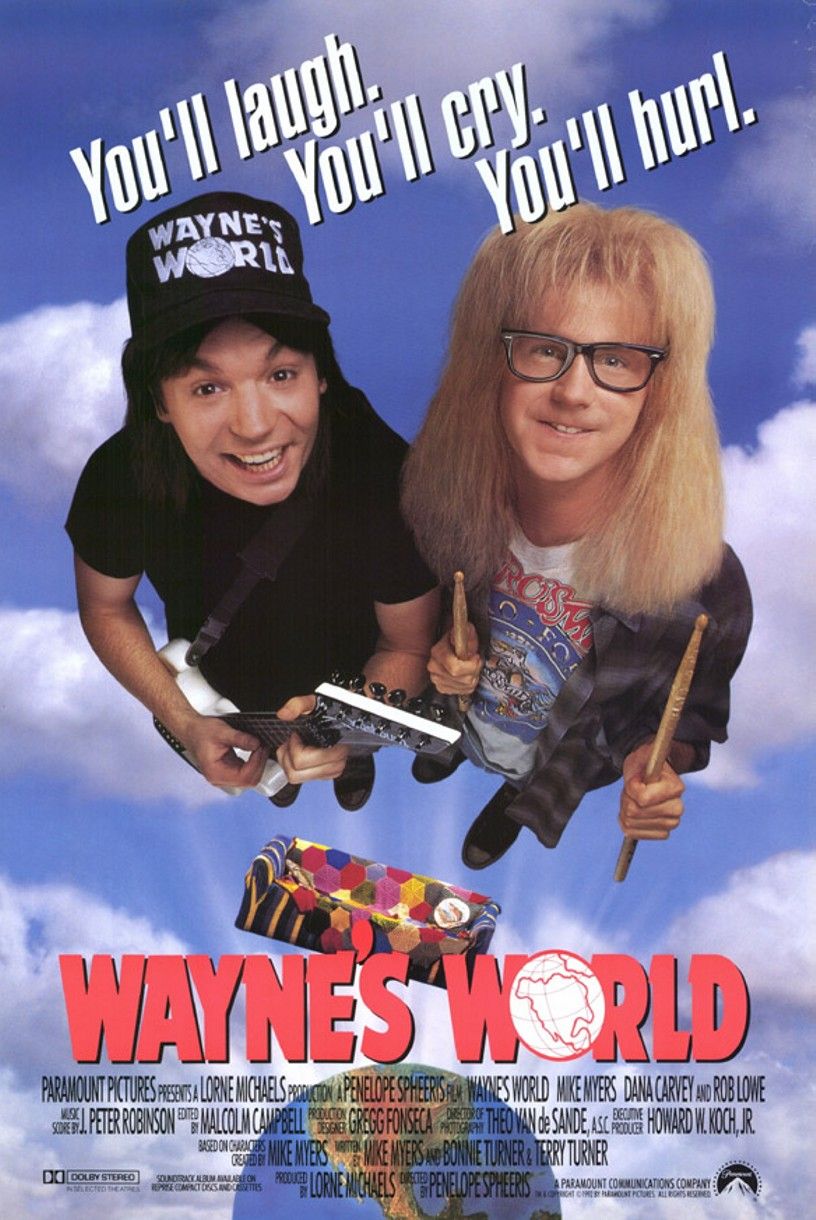
Wayne's World


365 Films

Entry #12

Wayne’s World (1992)

Directed by Penelope Spheeris


Believe it or not loyal reader(s?), there was a time when the prospect of a Mike Myers comedy didn’t fill audiences with a collective sense of dread.  There was a time when we used to sit on the edges of our seats, chewing our nails down to the nub with eager anticipation for whatever comedic capering Mr. Myers was cooking up his sleeve.  Wayne’s World is a perfect example of such a project.  Endlessly quotable, not afraid to take a dip into the warm springs of absurdity, and featuring a game ensemble that possesses the rare of gift of seeming to be making up the comedy as they go along, Wayne’s World stands alone.  That this also came from a recurring SNL sketch makes the accomplishment all the more remarkable.  Perhaps time has been kind to Wayne’s World in more than one way.  The most obvious being that it is genuinely funny and aside from the occasional dated reference here and there (they actually are few and far between), the humor is essentially timeless.  The second being that compared to the toxic-trash-burning-wasteland that is every other SNL sketch-to-film adaptations, it is hard to disagree with Wayne’s World being the “Citizen Kane” of SNL movies.  Sure, Coneheads had its moments (on second thought, maybe it didn’t), but Wayne’s World easily claims supremacy for its perfect distillation of the cultural moment.  At a time when the carpet bagging of the alternative/”grunge” scene had reached its saturation level in terms of mainstream domination, here comes Wayne’s World warning of the dangers of corporate usurpation of public access television.  I don’t think I’m grasping at straws here because looking at the film’s box office gross; clearly it connected with the general public.  The fact that it accomplished all this along with a throw-away reference to the movie Scanners, a generous amount of screen time devoted to Ed O’Neil’s intensely personal confessions of creepy and potentially threatening sentiments, and a police officer obsessed with full body cavity searches makes this film a treasure to be passed on from generation to generation.