Monday, February 11, 2013

Wayne's World


365 Films

Entry #12

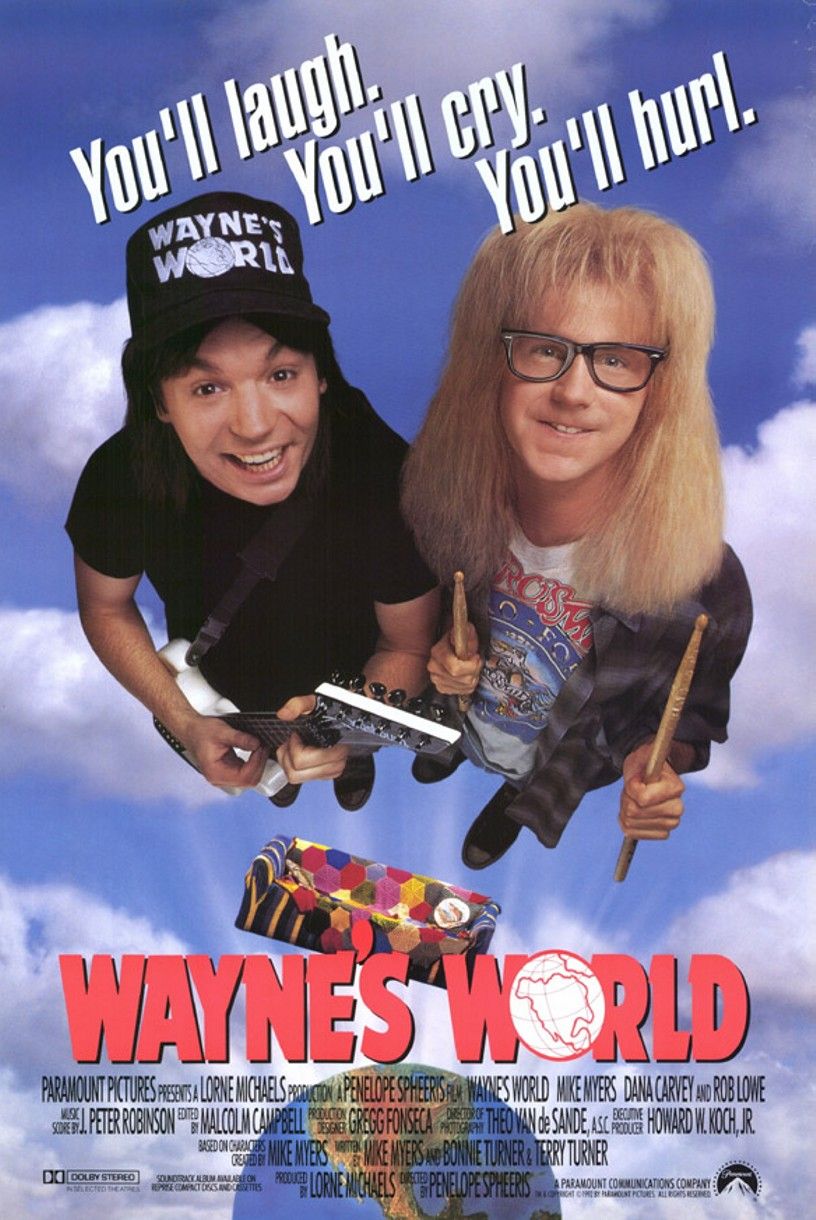
Wayne’s World (1992)

Directed by Penelope Spheeris


Believe it or not loyal reader(s?), there was a time when the prospect of a Mike Myers comedy didn’t fill audiences with a collective sense of dread.  There was a time when we used to sit on the edges of our seats, chewing our nails down to the nub with eager anticipation for whatever comedic capering Mr. Myers was cooking up his sleeve.  Wayne’s World is a perfect example of such a project.  Endlessly quotable, not afraid to take a dip into the warm springs of absurdity, and featuring a game ensemble that possesses the rare of gift of seeming to be making up the comedy as they go along, Wayne’s World stands alone.  That this also came from a recurring SNL sketch makes the accomplishment all the more remarkable.  Perhaps time has been kind to Wayne’s World in more than one way.  The most obvious being that it is genuinely funny and aside from the occasional dated reference here and there (they actually are few and far between), the humor is essentially timeless.  The second being that compared to the toxic-trash-burning-wasteland that is every other SNL sketch-to-film adaptations, it is hard to disagree with Wayne’s World being the “Citizen Kane” of SNL movies.  Sure, Coneheads had its moments (on second thought, maybe it didn’t), but Wayne’s World easily claims supremacy for its perfect distillation of the cultural moment.  At a time when the carpet bagging of the alternative/”grunge” scene had reached its saturation level in terms of mainstream domination, here comes Wayne’s World warning of the dangers of corporate usurpation of public access television.  I don’t think I’m grasping at straws here because looking at the film’s box office gross; clearly it connected with the general public.  The fact that it accomplished all this along with a throw-away reference to the movie Scanners, a generous amount of screen time devoted to Ed O’Neil’s intensely personal confessions of creepy and potentially threatening sentiments, and a police officer obsessed with full body cavity searches makes this film a treasure to be passed on from generation to generation. 


Sunday, February 10, 2013

Aladdin


365 Films

 Entry #11

Aladdin (1992)

Directed by Ron Clements, and John Musker


Here we come to a tricky proposition.  I’d be lying if I said I was the number one Aladdin super fan.  Hell, I’d be lying if I said I’ve even seen Aladdin within the last seven years.  I think I caught it on TV one random night a few years ago, actually.  The reason I am including it in this blog is because it is the first movie I can remember that produced tears of laughter from me.  In another of my “someone needs to write a dissertation about this incredibly useless subject” ideas, I propose that the ebb and flow of Robin Williams’ career from Aladdin to Patch Adams would make for a fascinating subject.  If you were of a certain age range when Aladdin came out, everything Robin Williams did was catnip for your funny bone.  Even a truly wretched, cloying, and manipulative piece of garbage like Mrs. Doubtfire became incredibly popular thanks to Mr. Williams’ antics (just ask Nate Carota).  Upon writing that last sentence, it occurred to me that a dissertation is not needed to trace the trajectory of Mr. Williams’ career. He is only following in a long line of promising stand-up comedians who eventually tumble down the “family film” rabbit hole, never to be seen again.  The reason I seem to be stuck on an infinite loop of analysis and then dis-crediting the analysis of Mr. Williams’ career is because his performance in Aladdin was revelatory to my young eyes.  All of it has kind of become standard boilerplate for Mr. Williams and animation voice-overs in general But! (Warning: I’m about to pull a fact straight out of my ass) I believe this was one of the first “celebrity” voice-over performances in the history of animation.  The first time that an actor in animation was asked to bring his previously established cinematic personality into the life of a character.  The Genie is what would happen if Robin Williams suddenly morphed into an animated version of himself.  From that point of view, it’s a fascinating and groundbreaking performance.  The argument can be made that this was not necessarily a good thing.  Animation was long the safe-haven for hard working, relatively anonymous voice-over artists, who bust their ass for an art form very few took seriously.  Robin Williams ushered in the era of lazy, paycheck cashing dub-work from a laundry list of actors whose names I won’t bother to mention here. This is all a roundabout way of saying that while I’ve retained little of Aladdin, (which I’m sure is blasphemy to some of my Disneyphiile friends, sorry!).  Robin Williams still makes me laugh my ass of when I watch it.  In hindsight, maybe this is a poor excuse for a 365 entry.  Then again, if I’m flipping around one day in the near future and Aladdin pops on, you can bet your magic carpet I’ll stick with it.  


Saturday, February 09, 2013

Batman Returns


365 Films

Entry #10

Batman Returns (1992)

Directed by Tim Burton


        If you’re beginning to notice a pattern regarding my lack of ability to catch first entries in movie trilogies, trust me, you’re not alone.  There isn’t any kind of “sexy” reason behind this, save for the fact that I was probably far too young to see the first Batman upon its original theatrical release.  I do not regret this turn of events in any way, shape, or form because Batman Returns was, and remains my favorite Batman movie to date.  Batman Returns contains one of the most disturbing opening sequences ever for a child to see in a comic book movie.  It begins innocently enough with a well-off Gothamite family living out a fairy tale existence in their snow-covered mansion of cavernous proportions.  From that point on, everything proceeds to fall completely the fuck apart with tragic consequences.  A baby is born, it makes horrible squawking sounds from its crib, and it possesses a pair of flippers instead of digits on its hand.  So far, so fucked up.  It gets worse.  The family reasons that it can’t bear the thought of a mutant-flipper baby and proceeds to drop it in the river as it sets sail for a new life in the comforting filth and waste of the sewer.  In what is perhaps Mr. Burton’s most diabolical twist of all; he casts Pee-Wee Herman as the patriarch of this cursed family.  Allow me to pepper a little context here into these next few sentences.  Batman Returns was released in June of 1992.  In July of 1991, Paul Reubens was arrested for public masturbation in a movie theater in Florida.  The point of all of this is to convey the sheer mind-blowing power of seeing Pee-Wee-Herman in a movie at all, let alone one where he plays a guy who drops his baby into the river. Granted, he wasn’t paying Pee-Wee, but I can still remember the reveal of his characters face as vividly as anything else in the movie.  So if I may step out of that bit of contextual table setting for a moment, the reason I have elaborated so specifically on the opening five minutes of Batman Returns is because this is one miserable super-hero movie.  If memory serves, Roger Ebert’s review of the film finds tremendous fault in this attribute.  I’ll have to respectfully disagree with Mr. Ebert because it is for this fact that I find Batman Returns to be the most satisfying of the entire series.  Batman Returns is the equivalent of a party populated by all of the weird, lonely, and off-putting characters from Mr. Burton’s entire career.  Only, the party sucks because the sense of community just makes everybody feel worse.  The characters in Batman Returns need to be in therapy followed by heavy doses of medication.  The word downer doesn’t even come close to adequately describing the grim specter of loss that cloaks this film.  Desires are suppressed until they not only rot the insides of the doomed individuals, but also destroy any chance of a genuine connection when they are finally released.  It’s grim, but in Burton’s hands also genuinely thrilling and alive.   


Friday, February 08, 2013

Malcolm X


365 Films

Entry #9

Malcolm X (1992)

Directed by Spike Lee


             This one is a doozy.  I have literally no idea where to begin with it.  If memory serves, the impetus for me to rent Malcolm X (I definitely did not see this in a theater) was based on research for a school biography paper of Malcolm X.  If that is any indication of what kind of student I was, then so be it.  From a young age I consistently maintained a strong predilection for the civil rights movement.  It’s kind of difficult to go to a Quaker school and not be somewhat enraptured by the speeches of King.  It’s only natural to assume that reading about the life of King and the actions of the SCLC would eventually lead me to the fascinating life story of Malcolm X.  In my movie-obsessed adolescent mind, I figured I could kill two birds with one stone by watching a movie and simultaneously absorb an incredible amount of research.  I got way more than I bargained for.  I have no idea what kind of paper I wrote based on that film (I’m sure it was terrible).  I have a very specific memory of my Mom and Brother purposefully keeping me from working on this paper because they wanted to go see some Brad Pitt snooze-fest called “Legends of the Fall.” I have never forgiven them for obstructing my studies.  Spike Lee has said in subsequent interviews that Malcolm X was a dream project for himself and cinematographer Ernest Dickerson when they met as graduate students in film school.  It is obvious from frame one that this film was made with fire in the belly.  It hits the ground running with an astonishingly vivid opening shot of  “Boston: The War Years” and never looks back.  Influenced by the opulent epics of Lean, Coppola, and Selznick, Spike Lee made what would become (and eventually bastardized) the new standard for the epic biographical film.  It’s well over three hours in length, spanning nearly the entirety of the first half of the twentieth century.  It features an incredibly deep bench of amazing performers in wonderfully nuanced roles, an unbelievable performance by Denzel Washington, and perhaps most memorably, an actual trip to Mecca.  Malcolm X is as captivating a piece of cinema that Hollywood has ever produced.  The film, of course, has its detractors who slam Mr. Lee with the usual pejoratives that he is sloppy, one-sided, and merely pushing a race-baiting agenda. Malcolm X is the perfect example of the kind of filmmaker Mr. Lee actually is as opposed to the angry ideologue he is most often painted as.  Malcolm X is a fascinating and complex portrait of a flawed, heroic human being that never forgets to be a gripping and dazzlingly cinematic story of America.  


Thursday, February 07, 2013

The Naked Gun 2 1/2: The Smell of Fear


365 Films

 Entry #8

The Naked Gun 2 ½ The Smell of Fear (1991)

Directed by David Zucker

You might wonder why I have selected the second Naked Gun film for inclusion on my 365 blog as opposed to the first.  In fact, I am wondering the exact same thing myself.  If my memory serves, the introduction I received to the Naked Gun films was through the second installment.  If I am mixing up the chronology here then this entire blog is essentially useless and for that, I apologize.  This film and the entirety of the Naked Gun series symbolize a bygone era of studio comedy.  If you’ll allow me to wax nostalgic for a moment, this was a sub-genre combining elements of screwball, slapstick, satire, silliness, and spoofing.  It was comedy as a perpetual joke machine with no larger purpose or genuine interest in telling a coherent story.  This kind of comedy obviously had it precedents (I hope nobody wants to tar and feather me for mentioning the Marx Brothers and Naked Gun in the same sentence), but something happened to it in the late 90’s/early 00’s.  It’s easy to pinpoint the exact film that made the entire genre collapse in on itself like a dying star (Scary Movie, cough).  Nowadays I can’t think of a more detested type of movie than the “spoof-everything-that-breathes” mutant bastard child of the Zucker-Abrahams-Zucker offspring. Epic Movie, Date Movie, Meet the Spartans, Vampires Suck, ugh, I’m pissing myself off just thinking about these ungodly pieces of shit.  In any event, Naked Gun is the apex of the genre and I am forever grateful to it for introducing me to the likes of Leslie Nielsen, George Kennedy, Robert Goulet, Priscilla Presley, Richard Griffits, and Orenthal the Murderin’ Bus Driver.  If I may also proceed with some dime-store psychoanalysis twenty-one years after the fact, Naked Gun 2 also contains some pretty strong progressive observations on the environment, the military-industrial complex, capitalism, and the American political system in general.  In fact, Naked Gun 2 began my long-running hatred of then Chief of Staff John Sununu.  That guy sucks.  I think it’s safe to say that the Naked Gun 2 ½ made me the man I am today. (Note to future DVD releases of the Naked Gun 2 1/2: please put that pull-quote on your DVD. Thank you.)  Cut to: 15 years later and the Zucker brothers have become 9/11-converted conservatives.  Go watch their coming-out party: “An American Carol”, or if you have eyeballs and a brain, don’t. 


This is Frank Drebin, Police Squad. Throw down your guns, and come on out with your hands up. Or come on out, then throw down your guns, whichever way you wanna do it. Just remember the two key elements here: one, guns to be thrown down; two, come on out!”


Wednesday, February 06, 2013

JFK

365 Films

 Entry #7

JFK (1991)

Directed by Oliver Stone

Holy mother of god is this movie fantastic and I have no shame in making such a statement. Nor do I have any problem admitting that movie is perhaps 99.9% bullshit, or that it might as well be the ravings of an ill-informed tea party-truther standing on a street corner.  I simply do not give a shit about any of that. This is one of the most ambitious, massively scaled, and flat out enthralling studio films ever made. I have heard the film referred to as a big budget experimental avant-garde art project and I would not disagree. The arsenal of cinematic tricks that Oliver Stone has at his disposal has never been put to better use (by him or maybe any director attempting something similar). What Stone has done here, with a merciless skill for presentation, is put you in the mindset of a conspiracy theorist. It’s a maddening place full of swirling, contradictory ideas and often-hallucinatory conclusions as the end result.  It’s intoxicating and no matter what you believe, by the end of JFK, Stone has convinced you of something. You might call that propaganda, but since the film pushes no clear solution, I find that to be a dubious charge. I think what Stone is getting at here is a generational disillusionment that kicked in after the most turbulent events of the 1960’s. The kind of disillusionment that produces far-flung, wacked-out theories about 11 dimensional chess moves being operated by all sectors of the government that act as a protective blanket for most rational explanations for real world horrors.  If you read about any man made or natural disaster in the last 30 years, you will also read about a guy who knows “the truth.” JFK documents the beginning of that collective agreement to live in denial.  But it's also about the noble pursuit of truth and justice in the face of incredible bureaucratic obstruction.  Where do you draw the line between obsession and what's really there in front of you?  Much to the contrary of the film's detractors, I believe Stone is asking a question, not making any kind of black and white case.  If this all sounds like a big dose of downer, fear not, for Stone had made an absolutely entertaining movie.  One could argue that beneath all the rage and rants, Stone has actually made a Frank Capra movie.  Watch Costner do his best Jimmy Stewart impression in the closing arguments as the prosecution for the trial.  As a result, the film never tastes like bitter medicine, just look at the parade of amazing character actors popping in and out of the film. Try not to watch the Mr. X monologue without your jaw dropping to the floor.  The amount of visual material with which the film arms itself is head spinning.  This is the kind of film where one sits back and marvels at a group of incredibly talented craftsmen working in harmonious synchronicity, as they produce with effortless grace what can only be described as a masterpiece.  


Tuesday, February 05, 2013

Terminator 2: Judgment Day


365 Films 

Entry #6

Terminator 2: Judgment Day (1991)

Directed by James Cameron

The raison d’être, as it were, for my formative cinephile years could be broken down to an oft-quoted prognosis of the inner workings of my mind. “Ethan will only see things with explosions in them.” “You wouldn’t have like it Ethan, there weren’t any explosions in it.” Such small-minded criteria haunted me for years, well into my teens as a matter of fact. It would be dishonest to deny these charges so I will use this as an entry to point to perhaps the most explosion-y of all action movies: Terminator 2. Being that I was only 7 when this came out, I can’t speak with 100% accuracy to the pure cultural phenomenon of the film. It’s safe to argue that this was perhaps my gateway drug to the idea of a “summer movie.” This shit was everywhere and astonishingly enough, incredibly accessible to mature young boys and girls of all ages even though it was a R-rated movie. Why? I have absolutely no idea. I chalk this up to writer/director James Cameron’s astonishingly innate ability to create pure pop culture events out of his cinematic ass. The idea of a new film by James Cameron now fills me with dread for that very reason.  Every film since T2 just irritates me more and more upon initial viewing and subsequent reflection (about which I’m sure he’s heartbroken, sleeping on a pile of money with many beautiful ladies).  There’s no denying that he’s a scarily talented craftsmen, I just feel like the entire success of the second Terminator film is due to the fact that it played incredibly well to a group of people who just wanted to see shit blow up (i.e. me). I watch T2 and I cringe at his awkward, horribly on-the-nose dialogue (something George Lucas is regularly raked over the coals for yet Cameron remains relatively unscathed).  The T2 screenplay is like an automaton trying to approximate human speech. Which, in all fairness, doesn’t really detract too much from the quality of the film. More to the point, it’s his simplistic view of human relationships and human nature that ultimately make the film a hollow experience. With all that being said, shit blows up real good in this movie and that car chase in the beginning is spectacular. The shoot out at sky-net is a terrific set piece. Linda Hamilton busts her ass to make Sarah Connor a compelling human being. And dammit, it is impossible not to be moved by the John and the Terminator’s goodbye scene. Ah fuck it, Cameron; you’ve done it again.  


Monday, February 04, 2013

Edward Scissorhands


365 Films

 Entry #5

Edward Scissorhands (1990)

Directed by Tim Burton


Unfortunately, these days one has to adopt an apologist stance when discussing the works of Tim Burton. 2012 was particularly rough on him when Dark Shadows and Frankenweenie were unfairly maligned by the fickle tastes of popular consensus. And that’s failing to mention the fact that his previous film was Alice in Wonderland. Enough said. This wasn’t always the case though, for throughout the late 80’s and into the 90’s he was the goth golden boy. And for my money, there aren’t many other films I can think of that demonstrate his wide array of talents as much as Edward Scissorhands. You’ll have to forgive me because my memory is failing me at the moment. I can’t remember if this was the first Burton I saw in theaters or if it was Batman. Nor can I remember if I had seen the immortal Pee Wee’s Big Adventure of Beetlejuice prior to this. Point being, this entry is of dubious origins, however, Edward Scissorhands is so good it doesn’t matter if I can’t come up with an interesting story behind it.  Scissorhands is perhaps Burton’s most successful modern day fairy tale in that it showcases an astonishing array of iconic moments that are steeped in genuine emotion. It’s a very rare thing for a film to achieve such a combination but Scissorhands makes it look effortless. As an introduction to the world of Burton, it is invaluable.  It’s also important to remember that this was a major career stepping-stone for the relatively new filmmaker. Up to this point his resume only included the previously mentioned films (and yes, yes the shorts and all those years he spent as a Disney animator. What am I, his biographer?) What those titles indicated was someone closer in spirit to a cinematic prankster than a genuine storyteller.  In the case of Batman, he was a spirited protector and tour guide of the public’s collective imagination. It was with Edward Scissorhands that all the pieces came together with the utmost eloquence. The production design, Danny Elfman’s score, the oddball comedic bits, and the immaculate performances under Burton’s visionary direction tell a story that is simply put: beautiful. 


Sunday, February 03, 2013

The Witches


365 Films

Entry #4

The Witches (1990)

Directed by Nicholas Roeg


This entry might be on the tricky side considering I can’t even remember the last time I watched The Witches. The reason I’m including it in this blog compilation is because it marks two firsts for my blossoming cinephilia and me. The first being that it marks one of the earliest occasions of being aware that a book had been adapted to film. Not only was I aware that this title existed as a book, but that it was a book written by Roald Dahl (who was my Woodstock at the time). Secondly, as far as I can remember, my initial contact with The Witches came through home video. To this date, I don’t think I’ve ever seen the film in its entirety in a theater.  That’s a shame.  Massive VHS consumption was a large part of my movie watching diet. I can vividly remember the weekly trips we made to the video store as holding as much promise as recess in School. Somebody much smarter and much more thoughtful than I will have to write the definitive account of how VHS/Laserdisc/DVD ushered in all of these newfangled viewing habits we’re always obsessing over and how significantly it changed film. Come to think of it, I’m sure that piece has been written, probably thousands of times over too.  Whew. In any event, The Witches is remarkably frightening and purposefully off-putting for a children’s film.  The Jim Henson creature design certainly doesn’t skimp on the nasty. The fact that they let the guy who made Walkabout direct a mainstream family film certainly suggests a bygone era of courage in studio filmmaking. The Witches may not have defibrillated my nerve endings the way Willy Wonka did (more on that later). But it is certainly a worthy addition to the Roald Dahl film adaptation pantheon.

Update: I happened to catch the Witches on television a couple weekends ago and let me assure you, the grotesqueries in this film know no bounds.  It is every bit as horrifying as I remember, and aside from an unnecessary sub-plot involving the hot naked affairs of Rowan Atkinson with the hotel staff, it remains a satisfying experience.  Aside from the creature effects, Anjelica Huston is the MVP of the whole enterprise.  The emphatic visual choices also carry a lot of the weight in brining Dahl’s world to the screen, made all the more remarkable by a seemingly limited budget. 


Saturday, February 02, 2013

Teenage Mutant Ninja Turtles


365 Films

Entry #3

Teenage Mutant Ninja Turtles (1990)

Directed by Steve Barron


Ah yes, my beloved turtles. In thinking about the best angle from which to approach this particular entry, I came up with a very simple observation: the teenage mutant ninja turtles owned all of my mental real estate for several years. If I wasn’t watching the animated series, I was watching the movies. If I wasn’t playing the video games, I was playing with the laundry bin full of action figures in my possession.  Yet, with all that immersion into Turtle paraphernalia, I don’t have the slightest idea what initiated my obsession. It must have been the cartoon, which premiered in 1987, and maybe the fact that they were green? (another one of my favorite colors). I remember an incredibly brief flirtation with karate around that time in my life (I think we’re talking about a lesson and a half, maybe less). And of course, like most children and adults, I gobbled up pizza without batting an eye. In that regard, The Teenage Mutant Ninja Turtles could not have been MORE up my alley. I remember an incredibly fervent sense of excitement the day before the release of TMNT: The Movie. I was aware of what this movie was, I was aware of what I would mentally acquire by seeing it, and I was super pumped for it. Which, in hindsight, is interesting because it speaks more to the marketing power of the TMNT brand than the actual quality of the film. An adult at the time would have to confirm this for me but something tells me that if you were a boy between the ages of 6 and 12 around 1990, you couldn’t get away from the TMNT marketing bonanza being shoved down your throat. Anyway, what does this have to do with the movie? I guess it’s a rather round about way of saying that I remember the hype more than the movie. Or rather, I’m not sure if my fondness for the film stems from its quality or the excitement that surrounded it.  I remember responding to Raphael and his bad attitude constantly getting him into physical and emotional trouble (I had a bit of a temper problem myself, plus he had the red head band so he was instantly my favorite). I’m glad the movie introduced me to Elias Koteas at such a young age, one of those actors who brighten up any movie in which he appears. And the movie delivers exactly what it promises: wisecracking mutant turtles karate chopping a gang of masked, pajama-wearing runaway youth. What more could a six-year-old ask for? 


Friday, February 01, 2013

Gremlins 2: The New Batch


365 Films

Entry #2

Gremlins 2: The New Batch (1990)

Directed by Joe Dante


I consider this phase in my cinematic upbringing to be the Looney Tunes period. Gremlins 2 and Who Framed Roger Rabbit both revel in the anarchic spirit of that wonderful animated enterprise. Gremlins 2: The New Batch is basically a live action series of Looney Tunes shorts wrapped around a barely-there wisp of a plot. That’s not meant to be a put-down, in fact, one of Gremlins 2’s most successful feats is the coup it stages at the palace of mainstream commercial cinema. The movie is so devoid of purpose and so full of mindless self-indulgence that it could really stand in as a “fuck you” to almost any sequel ever made. What sets Gremlins 2 apart is that it is deliriously funny. Again, it probably goes without saying, that none of this made any sense to me at the time of my initial viewing. I missed maybe 80% of the jokes, I didn’t get the satire at work (particularly the take down of Donald Trump’s New York), and in all honesty, I only went to see it because the lobby display had a cardboard animatronic gremlin popping in an out of a desk. That shit was cool. So while my abilities to absorb and understand the cultural critique were limited, the sense of fun the movie possesses was undeniably contagious. The movie breaks the fourth wall at the drop of a hat, and instead of feeling distanced; you feel like you are in on the joke. Perhaps that is because the movie itself can’t believe it’s getting away with half of the shit it does. I have to be totally honest here and admit my preference for Gremlins 2 as opposed to the original. I’m pretty sure I had seen Gremlins before seeing the sequel but my memory could be mixed up about that. It’s not that Gremlins is entirely inferior to its follow-up, but it’s certainly a lot grimmer and with a shockingly high body count for a movie of its type. All of these attributes could describe the far more impressive film. But for me being the age that I was and my then state of mind (Looney Tunes), I guess I wasn’t in the mood for mean and nasty.  And this was my cinematic introduction to New York City (more on that later), I’m sure that didn’t hurt. 


Thursday, January 31, 2013

Who Framed Roger Rabbit?


365 Films

Entry #1

Who Framed Roger Rabbit (1988)

Directed by Robert Zemeckis

We kick off my “knock-off” 365 blog with the granddaddy of them all, Who Framed Roger Rabbit. Don’t get me wrong, I don’t mean to imply that WFRR is the granddaddy of all cinema, just my perspective of it. This was the first film I remember seeing in theaters that actually registered with me on an image to eyeball producing pleasurable neurological connections level. This was also the film during which the infamous “skittle vomit” incident occurred. I feel that I can best sum up that story with a simple math equation: (Large bag of skittles+full dinner+2 Chocolate Milkshakes=Rainbow colored vomit all over the floor of the ladies room). I can’t quite remember what compelled me to want to see WFRR, I have a vague notion of liking the name Roger when I was four-years-old. It’s possible that an animated talking rabbit that dressed in red over-alls (one of my favorite colors) just really tickled my fancy. I don’t remember being aware of the fact that this was the first time that two titans of animation: Bugs Bunny and Mickey Mouse, had dropped their corporate entanglements and appeared on screen together. Nor do I remember being aware of the fact that basically every major character from the history of animation has at least a cameo in the film.  I especially don’t remember being aware of the fact that the film itself is a groundbreaking work in the history of cinema, seamlessly melding state of the art animation with live-action filmmaking. I think it was the rabbit in red-overalls that really did it for me. That being said, WFRR is an irreverent, eye-popping, whacked-out, screwball take on the Los Angeles noir genre. To my eyes at the time, I just liked watching that damn rabbit bumble around and fuck things up only to miraculously save the day at the end.  It’s been a while since I’ve re-visited WFRR. I remember my most recent viewing of it to be a little dis-heartening in that certain moments came off unnecessarily lecherous and creepy. So as to not end the first entry on a downer note, I will say that I look forward to introducing future generations to the exciting, pervy fun of Who Framed Roger Rabbit.  And to scare the living shit out of them with the concept of “dip.” 


A New Blog From A Stolen Idea.

Hello again,

       I know I've asked to go on many adventures with me here at anti-fanboy industries.  I hope you'll agree to join me for one more.  This time the adventure you seek will not be fraught with quoted song lyrics or frothing anticipation over a new Star Wars movie (again).  This time I wish to take you on a journey through 365 films that have defined the very man whose words you are reading at this very moment as we speak.  That's right, each day, you'll get a new blog entry of monumental importance about a movie I watched this one time.  There are some you might agree with, some you might disagree with, or the most likely option: you won't even have read the entry at all.  So sit back, read for a few minutes (seriously, each entry is just a paragraph long. what could you possibly have better to do), and then dive into the list of your own 365 films.

In closing, gentle reader, I'd like to thank you.`What's that?' you say? Me thanking you? No, it's not a misprint, for you see, I enjoyed writing this blog as much as you enjoyed reading it. The End.

I'll see you after the movie.

Wednesday, August 08, 2012

Vanilla Sky/Njósnavélin (The Nothing Song) (Untitled #4)


Cameron Crowe’s 2001 sci-fi-remake-romantic-psychological-Tom Cruise-phantasmagoric-drama was an incredibly divisive release in the waning days of that year. Okay, I added phantasmagoric for effect, and while I’m not entirely certain what genre that is; I know it’s definitely NOT Vanilla Sky. There were a handful of notable critics who found the heady mixture of pop-obsessed science fiction and vain white man redeems himself allegory to a be a complete disaster. Others, including myself, found it to be an ambitious, yet flawed, but ultimately moving work of one director purposefully impregnating another’s vision with his own directorial DNA. It’s a film where homage gives way to assimilation, and eventually domination. It might be a remake of a Spanish-language film, but Cameron Crowe is the only filmmaker who could have made this particular film.   
Upon exiting the theater that cold December day, (it might not have been cold, but this was back when weather used to match up with it’s seasonal alignment on a somewhat more consistent basis), the first thought that popped into my head was: “I think I liked nearly every single song on that soundtrack.” My brother Nate commented that he in fact “owned nearly every single song on that soundtrack.” The fact that music played such an integral part of the film should have come to no surprise. As this was the same director who gave us the In Your Eyes/Say Anything boom box moment, the Tiny Dancer/Almost Famous bus sing-a-long, and most certainly influenced my life long love of Pearl Jam with the inclusion of two of their tracks on the Singles soundtrack. A soundtrack, I should add, I bought when it came out when I had little to no interest in seeing the actual movie. I felt something different about Vanilla Sky, perhaps because it was a more modern collection of bands, and I was at the perfect age to discover that kind of music. Here is just an idea of the bands I eventually became enamored with because of Mr. Crowe’s track selection skills. Red House Painters, Mark Kozelek, Sun Kil Moon, Sigur Ros, Jonsi, Beth Orton, Chemical Brothers, Looper, Josh Rouse. Not to mention the acts I was previously acquainted with such as Bob Dylan, R.E.M., Radiohead, and Jeff Buckley. Spiritualized’s title track from their landmark album, “Ladies and Gentlemen We Are Floating In Space” was also used in the film, although not included in the soundtrack. In all fairness, Nate had previously introduced me to Spiritualized that fall with the use of a track in one of his student projects.
There was one band and one track that particularly stood out for me. Sadly, it was also not included on the actual soundtrack. It is the last piece of music used in the film (aside from the Paul McCartney end credits original), and it’s there to score the incredibly powerful ending. During the film’s release, it was only available as a live bootleg and it wouldn’t be until November of the next year, 2002, that it would gain a proper release. It is the song of many names. It is Sigur Ros’ Njósnavélin, aka, The Nothing Song, aka Untitled Track Number Four.
This song and sequence immediately grabbed my attention as soon as it began. One reason for this might be that the preceding 10-15 minutes are nothing but wall-to-wall necessary exposition. And in these moments, we are meant to challenge nearly every single piece of information we had been given by the film up to this point. Then again, maybe we aren’t. If the explanation were the end of the film, it would rob the story of the shot of adrenaline it had acquired wherein David Aames’ life starts to fall to absolute shit and chaos.  After this barrage of information, something interesting happens when Aames gets to the top floor of the literally sky-scraping building located in the middle of Manhattan. It gets quiet. Now, that’s not to say that the dialogue becomes non-existent and the film becomes nothing more than a selection of free-association abstract images. The dialogue that remains becomes a little sparser and a little more oblique. The lasting auditory effect we are left with is the music of Sigur Ros. What I love about how this particular piece is used, is that it is all at once: frightening, soothing, loud, quiet, distant, uncomfortably close, strange, and then ultimately as natural to the soundscape of the scene as the wind. With Jonsi’s otherworldly vocals, the wail of the lead guitar as it is played with a bow, and the steady pounding of the percussion, the song comes to reflect the ultimate fate of the world of David Aames. It’s important to make that distinction because this final scene is not just about the obliteration of one man, but of his entire world. Given that one of the titles of the track is Nothing Song, it makes sense that the scene attempts to capture both the creation and destruction of a way of life.   
Once Aames makes his leap, this is when I feel the film becomes its most eloquently expressive self, and it does this entirely free of dialogue. After some potentially (too) cutesy exchanges between David and Sofia, and a meta-audience-as-spectator-and-character-in-the-film-line from Noah Taylor, the dialogue is finished. Nothing Song takes over and David takes the plunge.  There are many ways to look at this and perhaps the most obvious is that the seed planted in the beginning of the film about David’s fear of heights had to be addressed eventually. Another is that taking a leap of faith was a common science fiction trope at the time, if you’ll recall the many sequences of people jumping in the original Matrix (a film without which, Vanilla Sky probably would never have been made). The interpretation that makes the most sense to me is that this is a suicide.  It is a suicide because he’s killing the life he has now and the world he’s always known. At the same time, he’s most certainly taking something with him. He is told he will wake up 150 years later in an all too real world with little more than the clothes on his back (or not, depending on what kind of future it is). His fate is yet to be determined and nothing will be in his control.  The song ultimately succeeds in this sequence because it conveys a tone that is at once hopeful and fatalistic. By selecting a song with such depth of emotion, Crowe seems to imply that within this death, there will be a life. Within the mad rush to the ground, there will be an epiphany. And finally that within the fabulous life of David Aames, a life over-flowing with consumption and excess, all it amounts to is nothing more than a series of fleeting memories.  Memories filled with life, but memories nonetheless. As past, present, future, family, pop-culture, friends, lovers, glances, shrugs, hugs, kisses, experiences, regrets, and the rest of the over-whelming nature of existence collide on impact, David truly opens his eye for the first time in his life.  The Nothing Song embraces the acceptance that we may never understand the ingredients that make up a life.  Imagine you are watching a home movie of yourself as a baby. Clearly, the events on screen transpired exactly as filmed. You were most certainly present during the filmed activities. Yet, it’s almost as if you’re looking at someone else’s life. You are watching someone else’s story.  What happened to the experiences and sensations you had to have felt? Will they all come rushing back to us the moment before it all ends?  The music of Sigur Ros and the films of Cameron Crowe do not pretend to come anywhere close to answering this question.  By presenting this moment with a flush of images, song lyrics written in an indecipherable made-up language, and a melody flushed with eloquent eeriness, they simply ask: when the time comes, what will you see? What do you want to see? 

Tuesday, May 22, 2012

Bottle Rocket/2000 Man


In honor of the release of the newest film by Wes Anderson, Moonrise Kingdom, fish and the whale presents a series of entries detailing a sequence from all six of Anderson’s previously released features. Each scene displays Anderson’s impeccable taste for using popular music and images in the most harmonious of unions. This is the Wonderful World of Wes.
I’m a little rusty on my screenwriting terms (so sue me, or remark upon how blatantly ignorant I am in the comments section), but I believe the scene from Bottle Rocket I have chosen would be the climax of the story. Dignan (Owen Wilson) is trapped at the site of one of the most mind-bogglingly inept robberies in the history of the universe. His brother Anthony (Luke Wilson), lookout man Bob Mapplethorpe (Robert Musgrave), safecracker Kumar (Kumar Pallana), and Apple-Jack (Jim Ponds, I’m not entirely sure what his job is), are fleeing from a cold-storage facility after the alarm has been tripped. Anthony and Dignan argue over who is going to return to the scene of the crime to rescue Apple-Jack, who has been felled by a heart attack (and he is the sole possessor of keys to their getaway van). The music playing over this section is part of Mark Mothersbaugh’s original score for the film. The tribal drums and the metronomic maracas, suggest perhaps an initiation ritual for Dignan. This is the ultimate test, the trial by fire for his 75 year plan; he could flee the scene of the crime or sacrifice himself for the well being of his fellow criminals. Dignan pleads with Anthony to let him go resorting to one of the most endearing declarations of leadership and power: “WHO is in charge here?” Claiming authority with a question is just one of Dignan’s incomparable achievements. This conversation leads to the most important dialogue spoken in the entire movie. Anthony tells him that he knows what will happen to him if he goes back to get Apple-Jack, Dignan replies, “No, I don’t. They’ll never catch me man, cause I’m fuckin’ innocent.”
The score quietly fades out and the camera pushes into Dignan’s face ever-so-slightly.  We watch Dignan’s eyes as they race through all manner of daring escapes he can make to avoid capture. It could also be read that they are illuminating his entire life for him up to this point as he prepares to make a decision that will no doubt radically alter it forever. Either way, the smile that begins to creep into Dignan’s face and the gentle acoustic strumming the opens the Rolling Stones’ 2000 Man, suggest that Dignan is not only living the dream, but about to play it out in real life. Decision made. It’s also important to note the sound design in this sequence; Anderson wisely leaves in the natural droning wind of the location. I have no idea whether this was live sound or taken from a library but let’s just assume the former for sake of argument, plus, it doesn’t really matter one way or the other. The sound of the drab storage facility wind is the boring life Dignan’s so absolutely petrified of.  That life is attempting to over-power the wistful tempo of the Rolling Stones. That life is attempting to shut off the movie that’s constantly playing in Dignan’s head.
The song completely takes over the soundtrack once Dignan takes off for the plant (save for some footsteps and yelling by the cops) and we are now in Dignan land.  It is here where Anderson cuts away from the robbery and reveals the twist of the story. The character of Mr. Henry (James Caan) reveals himself to be a small-time con-man who has cleaned out the house of Bob Mapplethorpe. He used Dignan as a surrogate son and protégé to get close to the rich friend. Over the shots of Caan organizing the moving van filled with Bob’s shit, Jagger sings about his name being a number and growing funny flowers on the window sill.  The chorus of the song is revealed as “Don’t you know, I’m a 2000 man. And my kids, they just don’t understand me at all.”  If you’ll indulge me to read WAY too much into this, I believe this is the final connection and, in effect, the severing of the chord between Dignan and Mr. Henry.   As the sequence of shots reveals, Mr. Henry is last seen in a low angle close-up, billowing cigar smoke from his mouth.  He has finally morphed into the imposing gangster figure we’ve been waiting for throughout the film. At the same time, he is left utterly and completely alone. His kind of thievery and Dignan’s brand are as different from each other as night and day. Take the very next cut of Dignan helping the ailing Apple-Jack to the van. His selflessness and humility stand in sharp contrast to Mr. Henry “I-got-mine-so-fuck-you” selfishness.  As much as Mr. Henry tried to mold Dignan into his apprentice, we now see that his failure is absolute and total.
Dignan’s sacrifice wouldn’t be complete without him actually having to sacrifice something. His valiant act of bravery aside, Dignan is still Dignan, and he locks himself out of the van. The music changes rhythm here completely. The cops corner Dignan, and we think this is the end. Then, as if spurred on by the faster tempo of the second part of the song, Dignan takes off back into the storage facility.  It is here, according to this writer, that the scene becomes iconic.  Wilson, in his banana-yellow jumpsuit armed with a gun, running away from the cops with exhilarating comic desperation. Nobody else can pull this off quite like Wes Anderson. It is here that the song begins to repeat the same set of lyrics over and over again, “Oh daddy, proud of your planet. Oh mummy, proud of your sun.” Note once again, the re-occurrence of the parent-child relationship reflected in the lyrics.  The only variance is in the following lyrics, which appear in the song when Dignan heads for the location of his eventual last stand: a giant fish freezer filled with ice. “Like it did when you were young. Or do you come down crashin. Seeing all the things you'd done. All was a big put on.” Dignan must now face the objective reality of his situation. Everything is about to come crashing down. He gets stuck in the freezer; the cops corner him, ignore his surrender, and begin to violently sub-due him. And even though he is getting repeatedly punched in the stomach, Dignan is still trying to talk his way out of it.
The last shot of the sequence is Dignan, handcuffed and led by the police out of the facility into a police car. The first thing that struck me about this final shot is how similar it looks (I guess it’s the other way around) like the shot in Rushmore of Max being led away by the police after Blume reports him for cutting the brakes on his car. The scene in Rushmore is an explosion of adolescent rage. The look on Max’s face as he’s pushed through the halls of his new high school and the pounding drums of The Who’s A Quick One While He’s Away convey this. In Bottle Rocket, the song reverts back to its original tempo and Jagger repeats the chorus. The look on Dignan’s face suggests an exhilarating defiance. He has finally achieved his dream of being a career criminal. We may not understand him at all, but we’ll follow Dignan wherever he goes. Why? Because he’s fuckin’ innocent.


Sunday, March 04, 2012

Smoke/Innocent When You Dream


I still can’t quite explain why the movie “Smoke” has stuck with me all these years. Perhaps it was the circumstances in which I first viewed the film, a sick day home from school, (at least, I think it was a sick day). I was lucky to have incredibly lenient parents when it came to movies I was allowed to see. The advantage is such that you are made aware of things that, simply, aren’t on your radar. Two other examples of sick day movies that spring to mind are What’s Eating Gilbert Grape and Don’t Look Back, two films, for which, I still hold a great deal of admiration. The lesson here is quite simple: accrue lots of sick days kids, that way your parents will let you watch a bunch of cool shit.

Miramax released Smoke in 1995, written by Paul Auster and directed by Wayne Wang. Interestingly enough, the possessive credit at the start of the movie reads: A Film By Wayne Wang and Paul Auster. It is definitely the product of two distinct personalities. Smoke was one of those Miramax Multiplex Art House movies that proliferated in the mid-90’s. I just coined that term so don’t bother looking it up, and if isn’t legit yet, try to spread it around. I’m referring to films made in the wake of Good Will Hunting and Pulp Fiction, the kinds of films Miramax hung their banner on for so many years. They were independent films, but they weren’t what you’d call provocative “art-house” movies. They had no intentions of rubbing your face in shit. At the same time, they weren’t glossed up the wazoo like big studio productions. There was a strong amount of integrity to these movies. They were singular visions, yet accessible at the same time. Smoke Signals, Chasing Amy, Brassed Off, Cop Land, and Rounders are the prime examples of how I was first introduced to “independent cinema.” A term, which seems fairly meaningless now, considering every single one of those, was actually released by the Walt Disney Company. I guess such distinctions escaped me at the time. I also remember yearning to one day have that Miramax logo in front of a film I had contributed to in some way. I thought that was the mountaintop and the rainbow behind it, the official sign that you’d made it.

I’ll give you all a minute to laugh at my inane naiveté. Yes, I had (and still have) a very dim grasp of the movie industry but I wasn’t even 14 yet, so lay off. Before this turns into a Miramax love-fest, I should explain that the reason for all this is to say; these movies introduced me to the idea that not everything had to have shoot-outs or ten explosions every five minutes to be worthy of my time. It could just be a movie about people…talking.

Talking, and all of its inherent glories, is precisely what Smoke has on its mind. The pleasures one takes from a conversation, the shared experiences, and that intangible connection are all created by the act of conversing. They are created and released into the atmosphere, only to disperse and evaporate instantly. It can be seen, heard and tasted, but the moment one tries to touch it, it’s gone. This all sounds a lot like…okay, I think I’ve laid it on pretty thick here.

The movie is the opposite of this, I should say, It’s light, witty, and quick on it’s feet. The story revolves around Auggie Wren (Harvey Keitel) who runs a cigar store on the corner of 16th Street and Prospect Park West in Brooklyn. The store is frequented by Paul Benjamin, (William Hurt) a writer struggling with the still-fresh random shooting death of his wife. Paul and Auggie have a long-standing friendship. As the film transpires, certain events occur to take Auggie and Paul out of their comfort zone, as they are each confronted by lost children. I suppose it is a bit disingenuous to describe the plot in a beat-by-beat action. Besides, I’m supposed to be talking about music, right? The film has more of a hangout vibe as it is, situations occur and characters react, but it is all within the realm of naturalistic forward momentum. That’s not to say there aren’t certain contrivances, moments where you can feel the writer struggling to pull everything together into some sort of cohesive “what does it all mean” statement, but those are few and far between. As it is, the film likes to sit back and observe these characters and more importantly, hear them talk.

This takes us to the final two sequences in the film. One is a lengthy monologue delivered by Auggie to Paul in a diner somewhere in Brooklyn. Paul has informed Auggie that the New York Times has asked him for a Christmas story to be published on Christmas day. Paul claims to not know any stories, so in exchange for lunch, Auggie agrees to share one with him. He claims that every word of is true. The second scene is played out during the film’s credits. It is a black and white, slow motion visual interpretation of Auggie’s story. The shot that connects the two sequences is a type- writer banging out the words: “Auggie Wren’s Christmas Story.” We hear the story, but we also see it re-constructed by Paul Benjamin for his piece in the times. (Note: Further wormhole inducing information, Auggie Wren’s Christmas Story was actually published in the New York Times on Christmas Day by Paul Auster). In the end, we are left with one story, but many different ways of telling it.

Over the black and white recreation of the story, the filmmakers used the song, “Innocent When You Dream” by Tom Waits. It was this exact scene; I remember it perfectly, when the film seared itself into my mind. From first viewing, this felt like the perfect ending to me. It doesn’t serve any story purpose, it doesn’t tie-up any of the still dangling threads we’ve just spent ninety minutes with, yet it ends on such grace that none of it matters anymore. I think a lot of that warmth has to do with the Waits song. There’s a lot of comfort to its accordion, merry-go-round melody and stumbling piano twinkles, and Waits’ voice is the perfect weapon to undercut any sneaky sentiment. What we have is, in effect, a time less song, one that very strongly indicates a yearning for the past, but in it’s lack of specificity in regards to catering to the popular music trends in which it was created, can be about a feeling we’ll always have. It’s the musical equivalent of smoke. Throw in the fact that Waits uses several of his own vocal tracks to make it sound like a drunken sing-a-long at a bar full of broken down losers and you have that ephemeral spirit of the film wrapped up in a perfect marriage of audio and visuals. As the song plays, the images are definitely the most stylized we’ve seen yet. Yet they never come across as flashy or meant to induce a music video by any stretch of the imagination. Neither do they ever plead with us to feel a certain way about the characters (this is, after all, a story of a man who steals a camera from an old blind woman). The images take their time, allowing the song to intermingle with the silent footage in ways that both compliment and enhance one another. The song gives this final sequence an almost fable-like quality. We quickly understand that it doesn’t really matter if it happened this way to the exact letter. What’s important is that Auggie gave Paul the story as a gift and now that story has taken on an identity of its own. The song is a punch-drunk, bleary-eyed howl of anguish. The visuals are more contemplative but we can see in Auggie’s fumbling attempt at making a connection with another human being that they are after the same thing. It is in that dichotomy, I believe, that the film achieves its true moment of grace. We can make a lot of noise about it, or we can sit down and share a meal with each other in silence. Either way, whatever it is we’re looking for and eventually find, will be gone by the time we realize it. That is why we keep looking, writing, smoking, talking, and dreaming.

 PS: Here is Auggie Wren's Christmas Story by Paul Auster, it's definitely worth a read.

Wednesday, February 29, 2012

Okay! That's been just about one moment...

Apologies for my absence. I'm sure in the ensuing years since we last spoke you have been forced to wander the barren wasteland known as the internet, in search of anything remotely resembling mental sustenance. I say to you now that your long and arduous search is over.

I have returned!

I should say, I'm writing this return post right now, which isn't to say I'll necessarily STICK TO IT this time. But let's roll the dice and see what happens. I had an idea for a blog a couple years back for some kind of examination of how music not specifically written for a film works in conjunction with the images. I believe there is a technical term for when a pop song is used on a soundtrack but it has escaped me at the moment. For one reason or another I never got around to starting this blog. Perhaps because there are ten-thousand other blogs with the exact same purpose being started, written, and subsequently abandoned as we speak. How do I offer to stand out in this immensely packed field? I don't. I'm just going to write about things that interest me and maybe some of you will come along.

Getting back to the point. Each post will examine a particular scene from a film, (I might do the occasional TV show every now and then but those will be few and far between) and I will try to offer my unique insight into the why of it all. Why was this scene chosen? Why does it work (or doesn't)? That's only two but I'm sure more will come up as I dive into this.

So sit back and get ready for some hopefully not copyrighted youtube clips and half-assed pseudo analysis of some of my favorite Songs and Images from the Movies.

PS: I'm not totally 100% crazy about this lay-out. If anybody has any ideas or contributions, feel free to share.